
“How Will the Government Sustain Universities?” – Conditions for a Sustainable Financial Model Proposed by the OECD
Explaining the financial crisis of universities solely through internal efficiency or student population decline is a superficial approach. The OECD 2025 Report clarifies that the sustainability of higher education finance is not just a management issue for individual universities; it is directly linked to national fiscal strategy, policy design, and the philosophy of public investment.
Universities are institutions where public interest and marketability exist in a state of tension. To secure stable financing, the government’s decisions on what to define as a public good and how to allocate funds act as decisive variables. This third installment explores how governments should support universities to create a sustainable system based on OECD data. The core lies in national choices regarding what, how much, and through which mechanisms to provide support—choices that will determine the future of universities.
Key Questions of Government Support: What, How Much, and How?
The OECD emphasizes that every nation must address three fundamental questions regarding higher education finance:
- The Question of Scope: Which university activities should be defined as public goods to receive stable funding?
- The Question of Volume: What level of total resources should be injected into higher education?
- The Question of Mechanism: Through what methods should these funds be distributed?
As the functions of higher education expand to include vocational training, lifelong education, and innovation ecosystems, the debate over whether all these functions are public goods has resurfaced. Furthermore, the OECD notes a structural mismatch: while universities perform more functions than ever, financial input has failed to keep pace with this expansion. Simply maintaining current investment ratios relative to GDP is no longer enough; the “appropriate” funding level must be redefined according to the functions society demands from universities.
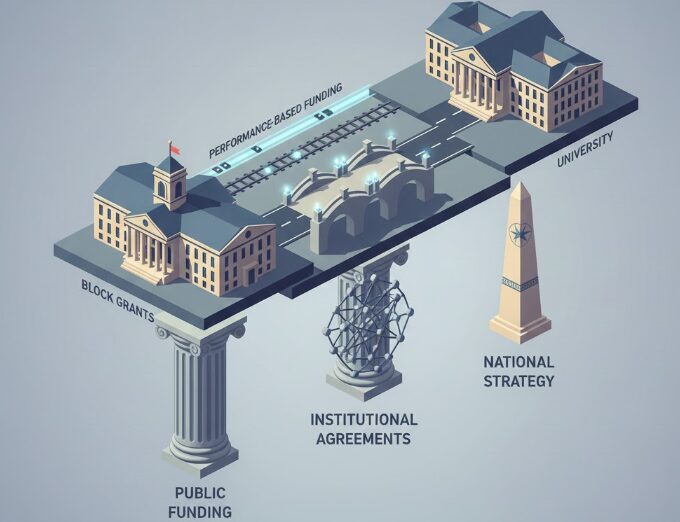
Block Grants and Performance-Based Funding: Diverse OECD Models
OECD countries primarily utilize two methods, often in combination, reflecting their respective operational philosophies:

- Block Grants: Based on the philosophy that governments must guarantee basic university operations, this model ensures institutional autonomy and long-term stability. This is particularly vital for research-intensive universities requiring consistent infrastructure investment.
- Performance-Based Funding (PBF): This model allocates resources or incentives based on specific indicators such as graduation rates, employability, and research output. Countries like Denmark and Finland utilize high proportions of PBF to enhance efficiency.
The OECD warns that while PBF is a popular tool for accountability, it can lead to structural distortions. Universities might sacrifice the quality of education or basic research to meet simplified quantitative targets, potentially widening the gap between elite institutions and regional universities that face tougher structural conditions.
Institutional Agreements: A New Relationship Model
To move beyond traditional allocation, many OECD nations are adopting Institutional Agreements. This is a model where the government and a university agree on specific goals and strategic directions for a set period, and resources are allocated accordingly.
This model is noteworthy because it emphasizes both autonomy and accountability. It allows for functional differentiation: a research university can focus on R&D excellence, while a regional university can prioritize community engagement. This strategic partnership increases predictability and aligns university strategies with national policy goals.
Vulnerability of Research Funding and the “Cross-Subsidization” Trap
A critical issue in the financial crisis is the structure of research funding. While research is a core function, it is often a loss-leading activity. External grants rarely cover the full indirect costs (overheads) such as laboratory maintenance, safety management, and administration.
As a result, universities often form a cross-subsidization structure, using tuition revenue (often from international students) to cover research deficits. The OECD identifies this as a “major source of invisible financial risk.” If education revenue is diverted to sustain research, the quality of education eventually declines. The OECD argues that since research is a public good, the state—not the university—should take responsibility for research infrastructure and indirect costs to ensure sustainability.
Strategy–Resource Alignment: A Shared Responsibility
A sustainable model requires Strategy–Resource Alignment. This means the government clearly defines the role of higher education and provides the necessary resources to fulfill that role consistently.
Because higher education is a long-term investment, inconsistent policy and funding make it impossible to drive planned changes. When strategy and resources are aligned, universities can reduce administrative burdens and focus on their primary functions, while governments can clearly verify the impact of their investments.
Lessons from International Cases: Why Some Succeed and Others Fail
- The Balanced Model: Denmark and Finland combine PBF with Block Grants to drive efficiency while maintaining basic stability.
- The High-Risk Model: The UK and Australia became heavily dependent on international student tuition, exposing them to extreme vulnerability during external shocks like the pandemic.
- The Strategic Model: Belgium, Portugal, and Austria utilize Institutional Agreements to reflect individual university characteristics.
The common thread in successful models is the presence of institutional devices that ensure financial predictability and a clear responsibility structure that respects university autonomy.
Conditions for Sustainability: Vision, Resources, and Mechanism
The OECD presents three essential conditions for sustainable higher education:
- Clear Vision: A national consensus on the role of universities must be the starting point for policy design.
- Sufficient Resources: Recognizing higher education as a public good requires stable, long-term fiscal commitment.
- Consistent Mechanisms: Designing tools (Block Grants, PBF, Agreements) that do not distort the essential nature of education and research.
Conclusion
Financial sustainability is not just a matter of numbers; it is a matter of direction. The fate of university finances cannot be resolved through internal efforts alone. It depends on the national fiscal philosophy and strategic choices. Only when the state provides sufficient resources and aligns them with a clear strategic vision can higher education move toward a stable future.
#HigherEducation #UniversityFinance #OECDReport #FinancialSustainability #PerformanceBasedFunding #BlockGrant #InstitutionalAgreements #EducationPolicy #HigherEducationReform #SpotlightU







답글 남기기