
The Collapse of Residency Training Hidden Behind the Medical School Quota Debate, and the Structural Issue of the ‘Doctor Training System’
Why Does the Medical School Quota Debate Repeat?
The debate over expanding medical school admission quotas is one of the most familiar scenes in Korean healthcare policy. A pattern has repeated several times: statistics showing a shortage of doctors are presented, an increase in admissions is proposed as a solution, and this is followed by backlash from the medical community and social conflict. The problem is that this debate always revolves around the numerical realm of “how many more to recruit.” While the phenomenon of a healthcare workforce shortage certainly exists, the process of explaining its causes and consequences has been overly simplified. Policy discussions have focused only on the starting point—medical school admission—rather than looking at the entire process of cultivating medical personnel. As a result, the core of the problem has been repeatedly bypassed.
Even in the recent process of promoting quota expansion, these limitations were clearly revealed. The policy presented indicators such as “the number of doctors per 1,000 people falls below the OECD average,” but failed to provide a sufficient explanation of the paths through which those doctors are trained and where or what roles they perform. The imbalance between regions and medical specialties, the shortage of essential healthcare personnel, and the concentration of doctors in large hospitals in the metropolitan area are issues that have been pointed out for a long time, yet all these phenomena were reduced back to a single cause: “the quota is too small.” In this process, the stages following medical school graduation—namely, residency training and the specialist training structure—were pushed out of the center of policy discussion. However, healthcare personnel do not exist simply as numbers. A doctor is not a workforce completed the moment they graduate from university; they are formed as professionals who function in the medical field through years of training after graduation. For an expansion of the medical school quota to actually lead to improved medical accessibility and the strengthening of essential healthcare, the path after admission must be examined as well. Nevertheless, policy discussions have repeatedly focused only on “expanding the entrance,” and as a result, the residency training structure—the most vulnerable point within the healthcare system—has long been excluded from structural review. As the quota debate repeats, the question that should be at the center of the problem is pushed back: not how many doctors to increase, but how to train them and what roles to assign them.
The ‘Hidden Bottleneck’ Revealed by the Collective Resignation of Residents
The collective resignation of medical residents in 2024 was an event that is difficult to interpret merely as a simple conflict or temporary clash. As residents left hospitals, medical sites, including large general hospitals, immediately revealed functional disorders. Outpatient treatments and surgeries were reduced, ward operations became unstable, and concerns were raised in emergency and essential departments that the personnel vacuum could lead directly to patient safety issues. This situation vividly demonstrated how much the Korean healthcare system has relied on the labor of residents. Legally, a resident is a doctor in training and a trainee receiving education. However, in reality, residents in hospitals have functioned as essential medical personnel before being subjects of education. A significant portion of tasks—including night shifts in wards, emergency responses, repetitive procedures, and administrative duties—fell to residents. This structure has been maintained for a long time as a practice and was not addressed as an institutional problem under the pretext of hospital operational efficiency. The reason the medical field was immediately shaken when residents left is that they were actually positioned as a core axis of the hospital’s personnel structure, rather than just trainees.
The collective resignation brought this hidden bottleneck to the surface. It became clear that hospitals could not operate without residents, and that a large portion of tasks that had not been replaced by specialists, nurses, or other medical personnel were concentrated on residents. This was not simply a matter of a labor shortage; it was a structural problem where the boundary between education and labor had collapsed. Residency training should be designed for educational purposes, but in reality, labor to maintain hospital operations has taken precedence. As long as this structure remains, improving the training environment or the quality of education is inevitably pushed aside as a secondary issue. More importantly, this bottleneck did not suddenly occur at a specific point in time. The poor training environment, long working hours, lack of rest, and the burden of tasks unrelated to education have been repeatedly pointed out through various surveys and reports. However, these issues were merely treated as the grievances or working conditions of individual residents, not interpreted as a structural problem sustaining the entire healthcare system. Only after the extreme situation of collective resignation occurred did the society begin to recognize that the residency training structure is a vulnerable point in the medical system.
Education or Labor? – The Dual Status of Residents
At the core of the residency training problem lies the dual status of residents. A resident is a medical professional with a doctor’s license, but at the same time, a trainee receiving training to obtain a specialist qualification. While laws and systems intend to protect residents based on this dual status, this distinction does not function clearly in actual hospital settings. Residents are expected to accept relatively low treatment and limited rights because they are trainees, while simultaneously bearing responsibility for patient care and medical accidents because they are doctors. The working conditions of residents starkly show this contradiction. Working nearly or exceeding 80 hours per week, continuous shifts lasting over 24 hours, insufficiently guaranteed rest and leave, and administrative burdens unrelated to education have become common scenes in the residency training environment. This form of work is closer to labor for hospital operations than training for educational purposes. Nevertheless, residents have often failed to fully secure rights and protections as workers, and their status as trainees has instead functioned as a justification for long working hours.
This dual status also directly affects the quality of training. For education-centered training to take place, sufficient guidance and feedback from teaching specialists, systematic educational programs, and step-by-step competency evaluations are prerequisites. In reality, however, guidance and education are deprioritized due to staff shortages and excessive workloads, and residents are deployed for repetitive medical and administrative tasks. In this process, training easily degenerates into a process of “enduring to fill time” rather than systematically acquiring professional competencies. Although the Medical Resident Act stipulates limits on training hours, guaranteed rest, and evaluations of the training environment to improve these problems, it has become clear that legal mechanisms alone cannot solve structural issues. Concerns are raised that if only working hours are restricted while the hospital’s personnel structure remains dependent on resident labor, problems such as a decline in the quality of education or gaps in medical services may occur. Ultimately, residency training is an issue where working conditions and the educational system cannot be approached separately, and a fundamental redesign of how residents are positioned is required. Whether to view residents as trainees, workers, or how to harmonize the two is not just a matter of simple legal amendment, but a task of redesigning the entire medical personnel training system.

Distortions Created by a Specialist-Centered Healthcare System
The background to the repeated deterioration of residency training problems lies in the structural characteristics of the Korean healthcare system. At its core is the Specialist-Centered Healthcare System. In Korea, the path of graduating from medical school, going through a residency, and obtaining a specialist qualification is perceived as the default path rather than an option. Cases of remaining in the medical field as a general practitioner (GP) are the exception, and without a specialist qualification, one is likely to be at a disadvantage in terms of status within medical institutions, compensation, and career prospects. Consequently, doctor training policies have naturally converged into “specialist training policies.” This structure distorts the distribution of medical personnel. The paths chosen by doctors after obtaining specialist qualifications are relatively clear: moving to large hospitals in the metropolitan area where clinical experience, research opportunities, compensation, and working conditions are concentrated, or entering private practice and specific non-reimbursable treatment areas. Conversely, regional medical institutions and essential departments bear a triple burden of heavy workloads, high legal risks, and relatively low compensation. Under these conditions, essential and regional healthcare remain only a matter of personal calling and fail to secure sustainability institutionally.
The specialist-centered structure also affects the residency training stage. Residents are regarded as future specialists and core hospital personnel, and hospitals utilize them to fill gaps in medical care. From an educational perspective, however, this harbors serious problems. Training should be a process of systematically accumulating professional competencies, but in reality, it often functions as a “rite of passage to become a specialist.” In a structure where qualifications are granted simply by enduring and working for a certain period, meeting time requirements easily takes precedence over the quality of training. In this process, the substance of education and evaluation is weakened, and resident burnout accumulates. Furthermore, the specialist-centered system makes doctor personnel policy linear. The logic that if there is a shortage of doctors, one simply needs to increase specialists naturally takes hold, followed by expectations that increasing specialists will improve medical accessibility. But reality is different. Even if the number of specialists increases, if they move to the same regions and the same types of medical institutions, the gaps in regional and essential healthcare will not be resolved. Instead, the concentration and competition in large hospitals will intensify, and both residents and specialists may be exposed to higher work intensity. Thus, residency training problems need to be understood as a result of a medical personnel structure designed around specialists, rather than an issue of individual systems.
How Major Countries Train Doctors
To understand the residency training problem structurally, it is necessary to look at how other countries train doctors. Cases from major countries commonly show that they invest more institutional energy into “how to train and deploy doctors” than “how many doctors to recruit.” These countries do not leave residency training as a simple internal hospital matter but treat it as a national-level education and personnel policy.
In the United States, residency training is operated primarily through independent accreditation bodies. Medical education and training programs must be accredited according to national standards, and accreditation is directly linked to financial support. This acts as a mechanism that institutionally restricts hospitals from using residents simply as a workforce. Training programs must have clear educational goals and evaluation systems, and the roles and responsibilities of teaching specialists are strictly regulated. Working hours and rest standards are also managed from the perspectives of educational quality and patient safety.
The United Kingdom manages residency training within the National Health Service (NHS) system. The state takes financial responsibility for the education and employment of residents, and hospitals fulfill their roles as education providers. The training process is divided into stages and designed as an integrated form of common and professional competencies. In this process, the status of residents as trainees is clearly recognized, and the quality of training is subject to national evaluation and supervision. A distinctive feature is that the boundary between education and labor can be managed institutionally because the financial burden of residency training is not transferred to the hospital.
Canada also treats residency training as an extension of education policy. Resident education is operated centered on medical schools, and the government provides financial support but does not excessively intervene in the educational content or operation. Professional organizations and educational institutions manage the quality of training with autonomy, and the state and society support this structure. In this process, residents are positioned as part of the national medical personnel training system rather than as the workforce of a specific hospital.
Japan manages residency training as a public domain through a structure where the state fully supports initial training after medical school graduation. In subsequent stages, local governments and the state are financially involved, encouraging regional training and deployment. This structure does not reduce training to a hospital-level issue but connects it with the policy goal of regional balance in medical personnel.
Cases from these countries show one commonality: the recognition that residency training is not an internal operational issue for hospitals, but an education and personnel policy for which the state must take responsibility. Unless quality of education, working conditions, and financial responsibility are designed separately, residents can always be reduced to cheap labor. Conversely, when training is placed under public responsibility, there is room to manage the boundaries of education and labor and design a long-term medical personnel structure. The reason residency training problems repeat in Korea can be seen as the absence of a consensus on the extent to which residency training should be viewed as a public responsibility, rather than a mere deficiency in the system.
Why is Korea Obsessed Only with Quota Expansion?
Then, the question naturally follows: Major countries design doctor training multi-layeredly as an issue of education and personnel policy, so why does the policy debate in Korea repeatedly converge on the single solution of expanding medical school quotas? This is closer to a result of how Korean healthcare and higher education policies have functioned together, rather than a simple error in judgment by policymakers.
First, a short-term performance-oriented policy structure has been in operation. Quota expansion is a policy tool that can present immediate results in numbers. It is possible to calculate how many people were increased and how much the supply will increase after several years, making it easy to convey as a policy message. In contrast, overhauling the residency training structure, redesigning the specialist training path, and building essential and regional healthcare tracks require a long time for results to become visible and involve various interest adjustments. In this process, policy has naturally tilted toward “expansion” rather than “design.”
Second is the issue of financial responsibility. If residency training is recognized as public education, the state must clearly bear financial responsibility for educational costs and personnel training. However, residency training in Korea has long been treated as an internal hospital matter, with the state remaining in the role of managing through legal regulations and evaluations. The burden of training costs and personnel operation was passed on to hospitals, which responded by absorbing them through resident labor. In this structure, the state tends to prefer policies like quota expansion, where the cost burden is relatively dispersed.
Third is the fragmentation between the healthcare delivery system and education policy. While medical school quota policy is an area where the Ministry of Education and the Ministry of Health and Welfare intersect, residency training and specialist training have mainly been handled as sub-sectors of healthcare policy. Because of this, doctor training has not been designed as a single continuous path, and the stages of admission, graduation, training, and specialization are operated under different logics. While quota expansion is easily promoted as an education policy, structural problems in the subsequent stages easily remain in policy blind spots.
As these conditions overlap, Korea’s medical personnel policy has repeatedly relied on “expanding the entrance.” However, the collective resignation of residents clearly revealed the limitations of this approach. It confirmed that increasing numbers alone cannot compensate for the vulnerabilities of the healthcare system and may instead result in stacking more personnel on top of an already distorted structure.
Improving Residency Training is Education Policy, Not Healthcare Policy
The reason discussions surrounding residency training problems repeatedly face difficulties is that they have been treated only as issues of medical labor or working environments. Of course, the working hours, treatment, safety, and rest of residents are important issues. However, the essence of residency training is closer to an educational issue than a labor issue. A resident is not just a hospital’s workforce, but a professional workforce that the state must nurture, and the process should be understood as professional education in the post-higher education stage.
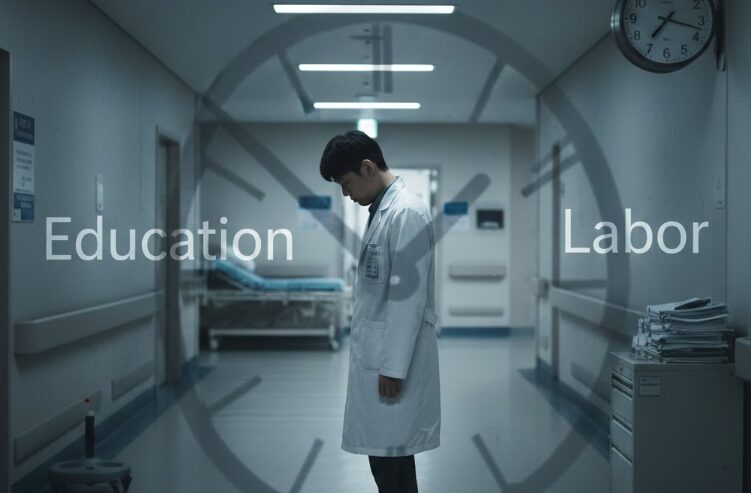
When training is premised as education, the questions change: What competencies should residents acquire step-by-step? What role should teaching specialists perform in that process? How is the quality of education evaluated and fed back? These become the focus. Restricting working hours is a means to achieve this goal, not an end in itself. If only time regulations are strengthened without clear educational goals, side effects such as a decline in the quality of training or instability in hospital operation may occur.
Cases from major countries provide important implications at this point. These countries do not leave residency training to the hospital’s autonomy; instead, the state or public bodies design educational standards and financial responsibilities together. The accreditation and evaluation of training programs are linked to financial support, and the educational responsibility of teaching specialists is also institutionally prescribed. This is a minimum safety net to prevent residency training from degenerating into a cost-cutting measure for hospitals. In Korea, there is a need to clearly position residency training in the realm of education policy. This is not a problem that can be solved by simple amendment of the Medical Resident Act alone. The overall system must be redesigned so that the evaluation of the training environment is effective, results are transparently disclosed, and the quality of education and the role of teaching specialists actually function. Simultaneously, unless the state’s financial responsibility for training costs is gradually expanded, the goal of education-centered training is likely to remain a mere declaration. A transition is required to recognize residency training not as a burden on the medical field, but as a national investment in personnel training.
Instead of Increasing Doctors, We Must Redesign Doctors
The debate over expanding the medical school quota eventually converges into one question: How is Korean society training doctors, and what roles does it expect from them? Policies thus far have managed the problem by increasing numbers without sufficiently answering this question. However, the collapse of the residency training environment and the instability of the healthcare system show that this approach has reached its limits.
Redesigning doctors does not simply mean adjusting quotas. It means diversifying the paths after medical school graduation and restructuring so that general practitioners, family doctors, regional doctors, and specialists can each have independent expertise and career paths. It also includes institutionally supporting education, compensation, and career design so that essential and regional healthcare do not rely only on individual sacrifice or a sense of calling. Without such design, even if the number of specialists increases, the problems of concentration in the metropolitan area and the gap in essential healthcare will inevitably repeat.
Residency training lies at the heart of this redesign. If training fails to function as education, specialist training degenerates into a simple qualification process, and the quality and sustainability of the medical workforce are threatened. Conversely, if residency training is redefined as public education and designed responsibly by the state, a foundation can be laid to restore stability and trust across the healthcare system.
The question of whether to increase doctors has been discussed enough. The question needed now is different: What kind of doctors are needed? How will we train them? And to what extent will society take responsibility for that process? The uncomfortable questions posed by the medical residency report eventually show the fact that Korean healthcare and education policies can no longer be separated. Unless this question is answered, the medical school quota debate is likely to repeat in the same place in the future.
#MedicalResident #MedicalSchoolQuota #HealthcarePolicy #EssentialHealthcare #RegionalHealthcare #Specialist #DoctorTraining #TrainingEnvironment #MedicalEducation #SpotlightU




답글 남기기