

AI Has Begun to Transform the Essence of Strategic Foresight
Strategic foresight always begins with imagining the future. However, in the mid-2020s, with rapidly expanding uncertainty and complexity, reading the future is no longer sufficient with just expert intuition or past data analysis. A joint report by the World Economic Forum (WEF) and the OECD highlights this point, showing that AI has begun to fundamentally change the way strategic foresight and future forecasting are conducted. Traditionally, future strategy relied on human experience, interpretation, and slow-paced data collection. With the advent of Generative AI, however, it is now possible to scan data dozens of times faster than before, reconstruct vast amounts of information, and draft various scenarios in just minutes. This change is not merely a matter of efficiency; it signifies a ‘structural transition in the way we view the future.’
Strategic foresight practitioners have long had to sift through massive amounts of data to analyze trends, detect weak signals, and identify signs of structural change. But AI is now rapidly automating these initial exploration stages. The report prominently raises the concern that the strategic foresight process itself may be reorganized around technology. Technology reduces the analytical burden but also creates new risks. AI expands the range of possibilities ahead, while simultaneously carrying the risk of distorting those possibilities. Therefore, the adoption of AI in strategic foresight is moving from a question of choice to a question of ‘how to utilize it.’ The process of finding the answer to that question forms the subject of this entire article.
The Language of Strategic Foresight Changed by AI – Key Frameworks Presented in the Report
The core of strategic foresight is not to predict a single future. It is about grasping layers of various possibilities, exploring the pathways through which those changes might unfold, and interpreting what each scenario means for an organization. Human imagination and critical thinking have been essential for this work, but the volume of information and depth of analysis a single person can handle were limited. The report emphasizes that these limitations can be structurally augmented by AI, summarizing the changes AI brings to strategic foresight with a few key concepts.
The first change is ‘augmentation.’ Rather than replacing human judgment, AI reduces the time spent on initial analysis and data organization, allowing strategists to devote more time to interpretation and judgment. The second is ‘democratization.’ Previously, only governments and large corporations with sufficient personnel and budget could afford future strategy organizations, but now low-cost AI tools are drawing a wider range of organizations into this domain.
AI also simultaneously creates the contradictory possibilities of automation and distortion in strategic foresight. Automation can handle most repetitive tasks, such as generating strategy drafts, analyzing patterns, comparing scenarios, and scanning for signals. However, because the analyses generated by AI are often data-driven and based on past knowledge, there is a risk of weakening future-oriented thinking. Given that strategic foresight fundamentally requires the ability to imagine ‘what does not yet exist,’ the role of AI is necessarily limited. Despite these limitations, the report evaluates that AI is creating a new language for the formulation of future strategies. Technology is not replacing human capabilities; instead, it is restructuring the premises and processes of existing approaches, offering strategic foresight practitioners a new framework for imagination.
AI Utilization Status Based on Global Data – What 167 Future Foresight Experts Say
The most practical clue regarding how AI is being used in strategic foresight is found in an international survey conducted jointly by the WEF and the OECD. The report is based on the responses of 167 strategic foresight experts from 55 countries, and an analysis of this data confirms that the adoption of AI is not just a technological innovation but is restructuring the entire strategic planning environment.
The most notable feature is the ‘sectoral capability gap.’ While 93% of private sector experts responded that they “have sufficient technical capacity to utilize AI,” this figure was only 53% for the public sector and 59% for academia. This suggests that the public and academic sectors are much slower in adopting technology than the private sector, and that structural factors such as data regulation, security issues, and organizational culture are widening this gap. Considering the reality of universities and public institutions in Korea, the AI capability gap in strategic foresight is highly likely to widen further.
Looking at the actual application areas of AI, three domains were overwhelmingly prevalent: Trend analysis was highest at 69%, followed by Future scenario development (63%), and Weak signal detection and horizon scanning (60%). This shows that AI is acting as a very powerful tool in the initial stages of strategic foresight—namely, the task of ‘organizing vast information and extracting meaningful patterns.’ Academic researchers, in particular, tended to actively utilize AI for horizon scanning, while corporate strategy teams focused on scenario development.
In addition, respondents were using a combination of various tools, including ChatGPT, Claude, Gemini, Perplexity, and CoPilot, with some advanced users reporting utilizing 30 to 50 tools simultaneously. In fact, cases introduced in the report included organizations that have built and use customized internal AI platforms integrating information gathering, signal detection, and analysis automation. This suggests that AI is evolving not as a single tool but as a component of a ‘strategy tool ecosystem.’
This data implies that the future of strategic foresight has already entered a new phase. In the past, only large organizations could possess future forecasting capabilities, but now, with the emergence of various AI-based tools, the barriers of scale, budget, and expertise are being lowered. As a result, strategic foresight is gradually moving from a closed domain centered on experts to an open and multi-layered one.
However, this change is also a warning sign. While some experts strengthen their analytical power by utilizing advanced AI tools, others may lag behind in strategic competition due to a lack of technical understanding. Ultimately, an era is arriving where the ability to utilize AI in strategic foresight translates directly into an institution’s competitiveness, a point that Korean universities and the government must prioritize in their response.
Three Levels of AI Utilization – From Augmentation to Full Integration
The report classifies AI utilization in strategic foresight into three levels, which represent a ‘maturity model’ showing up to what stage of the strategic foresight process an organization utilizes AI, rather than just technical proficiency.
The first level is the analytical assistance level. At this stage, AI is used for scraping, summarizing, and sorting materials. Time-consuming tasks in the initial investigation stage are shortened, increasing overall work efficiency by about 10-15%, but the core tasks of interpreting results and setting direction still remain with humans. Most AI utilization in Korean universities and public institutions currently falls under this level. The characteristic of this stage is that it is close to ‘tool usage.’ The interaction occurs as the user issues a command to the AI, and the AI provides the result.
The second level is utilizing AI as a ‘creative partner.’ At this stage, the relationship develops where the strategic foresight practitioner has the AI review self-created scenarios or analytical frameworks, or, conversely, evaluates the possibilities suggested by the AI, engaging in mutual feedback. For example, the AI might first suggest mega-trends of future change or a structure of stakeholders who would be affected by a specific event, which the human then verifies and modifies. The characteristic of this stage is that humans and AI exchange mutual feedback. It is not simple automation; the expansion of thought and comparison/contrast work are carried out with AI. Strategy departments in private companies and some international organizations have reached this level, and the report assesses that productivity significantly increases starting from this stage.
The third level is the form where AI is completely internalized into the strategic foresight process. Although this stage is still only experimentally implemented in some organizations, it is the most significant in terms of gauging the future direction of strategic foresight. At this level, AI comprehensively supports the entire process, from weak signal detection, pattern analysis, scenario generation, policy simulation, impact analysis, to the visualization of the final outcome. The strategic foresight practitioner assumes the role of an ‘overseer,’ evaluating and adjusting the results, rather than engaging in the initial analysis stage. That is, the human role shifts from ‘data handling expert’ to ‘interpreter and responsible decision-maker.’ The report assesses that only a handful of institutions have currently reached this stage but projects that this model is highly likely to become the new standard before long, considering the speed of technological development.
Advantages and Risks of AI – Simultaneously Revealing the Possibilities and Limits of Strategic Foresight
The most distinct change AI brings to strategic foresight is the ‘compression of time.’ According to the report, the greatest advantage of AI cited by strategic foresight experts was its ability to accelerate the entire process by rapidly handling repetitive tasks. The significant reduction in time spent collecting and summarizing research materials allows strategists to concentrate on higher-level analysis and scenario review. This is highly significant as it goes beyond simple efficiency improvement to enhance the core function of strategic foresight. When tasks like data-based trend analysis, large-scale literature review, and stakeholder mapping are automated, the speed of strategy formulation and the responsiveness of the entire institution increase. In particular, the expansion of data analysis capabilities, emphasized by 17% of experts, enables the discovery of new signals within large-scale unstructured data that was difficult for human analysts to access. AI acts to show new possibilities by scanning diverse materials simultaneously and connecting information from different domains.
However, the risks of AI are just as clearly evident as its advantages. The basic premise of strategic foresight is that ‘the future is not a simple extension of the past.’ But AI is fundamentally a technology that learns based on past data and existing patterns, so it can potentially weaken the future-oriented perspective. The most frequently mentioned risk in the report was the ‘reliability issue’ related to this point. Many experts reported experiencing the problem of hallucination, where AI often presents shallow and fragmented analysis or includes logical leaps and errors. This imperfection can cause serious problems, especially in areas with high social impact, such as public policy or large-scale education and research strategies. Moreover, the lack of transparency in AI’s decision-making process is fatal in strategic foresight. If the grounds on which AI proposes a specific scenario are not sufficiently explained, it is impossible to properly answer the question, ‘Why should we choose this option?’ during the decision-making process.
Another significant risk in adopting AI for strategic foresight is the widening of the internal capability gap within organizations. The report points out that unlike the private sector, the public sector is constrained in AI utilization by security regulations and bureaucratic structures, with 40% of public institution strategy managers admitting they “do not have sufficient capacity to handle the technology.” This implies the possibility of unbalanced development of strategic foresight capabilities at the national level. Experts also pointed to the problem of ‘overconfidence’ brought by AI. The more immediate and sophisticated the analysis presented by AI appears, the more people tend to accept the results without deep scrutiny. This can weaken the critical thinking and creative interpretation required in strategic foresight, ultimately leading to a reduction in strategic thinking capability itself. That is, AI can strengthen strategic foresight, but without proper governance and training, it also has the potential to decrease forecasting ability.
How Do Future Foresight Experts View the Future of AI?
In the process of AI reshaping the methods and ecosystem of strategic foresight, experts expressed both diverse expectations and concerns. According to the report, 65% of respondents answered that “the level of risk AI brings depends on the way it is applied and its governance,” seeing the core issue as ‘how it is managed and designed’ rather than the technology itself. This shows that a more mature perspective—neither blind praise nor excessive fear of the technology—is taking root in strategic foresight. Nonetheless, 19% of experts perceived a “medium level of risk,” and 6% expressed concerns that “AI could seriously undermine strategic foresight.” Their common criticism was that AI can create unexpected distortions in the process of exploring the future. There is a risk that AI might overly emphasize specific patterns or overlook low-probability events during the analysis process.
The question of how AI will change the role of strategic foresight experts also yielded interesting results. Among experts with AI experience, 18% responded that “AI will reduce their role,” but 32% believed that “AI will enhance their capabilities.” This suggests that the technology is likely to lead to a reorganization of roles—where AI handles simple data organization and analysis, and human experts concentrate more on interpretation and judgment—rather than replacing jobs entirely. Experts particularly noted that as the efficiency of scenario analysis and environmental scanning utilizing AI increases, the scope for strategic foresight practitioners to explore more alternative futures and compare diverse perspectives has expanded. Therefore, AI was not threatening the profession itself but was changing the nature of the work toward demanding greater specialization in strategic foresight.
An interesting observation is that the experience of using AI tools creates a significant difference in experts’ perceptions. Experts who have actually utilized AI tools in their work responded that AI will make a greater contribution to decision-making and strategy formulation, whereas experts without experience were relatively skeptical. For instance, 22% of AI experienced individuals believed that “AI will play a strong positive role in integrating strategic foresight into organizational decision-making,” but the proportion was only half among the non-experienced. This shows that technological experience influences strategic judgment and explains why organization-wide technical education and the enhancement of AI literacy are important. The report warns that this perception gap may cause internal imbalances in strategic foresight in the future. If the judgment structure differs between experts who understand technology and those who do not, a situation could arise where different strategies are formulated based on the same data.
AI Now Creates a Gap in National ‘Foresight Capability’
The WEF and OECD reports emphasize that AI is not just a technology that increases work efficiency but is becoming a key factor determining the ‘foresight capability’ of nations and organizations. While traditional factors like economic scale, demographic structure, and industrial base used to determine national competitiveness, the ‘ability to detect and respond to the future’ is likely to replace them. Foresight capability is not the ability to solve immediate problems but the ability to identify and prepare for problems that have not yet occurred. This becomes the criterion that determines how strategically a nation can move amidst complex crises such as climate change, population decline, geopolitical conflict, and industrial fluctuation. AI can reinforce this foresight capability while simultaneously acting as a tool that significantly widens the gap between nations that possess it and those that do not.
As evident in the report data, the private sector is rapidly adopting AI-based strategic foresight, but the public sector is slow to adopt due to a lack of technical capacity and ethical/security constraints. If this gap persists, public policy agility will decline, and society as a whole will acquire the structural weakness of failing to keep up with the speed of change.
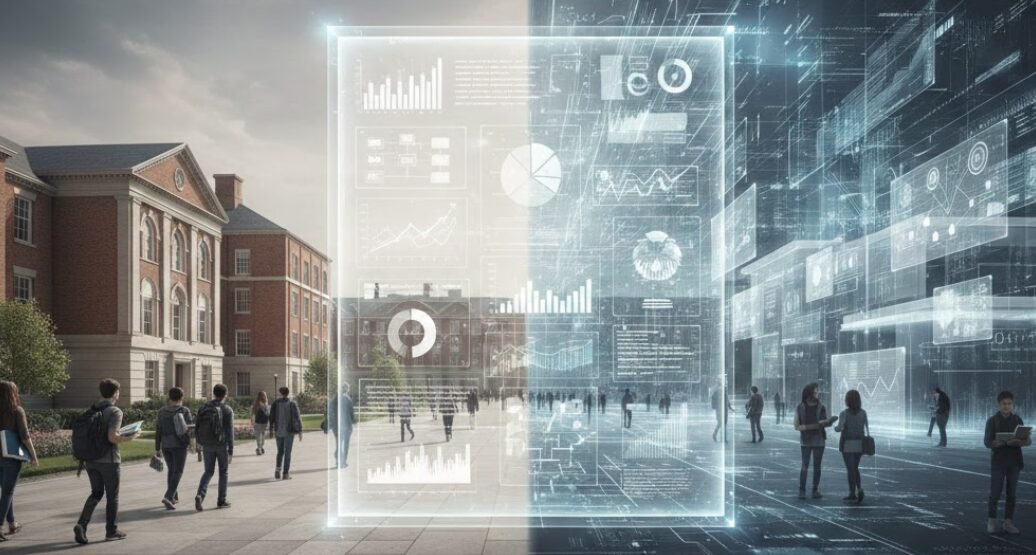
Similar problems are already appearing in university strategic foresight systems. Major global universities are actively adopting AI-based scenario analysis, prediction of admissions changes, and research outcome analysis tools, changing the way they establish mid-to-long-term plans. Leading universities in the US and Europe are designing departmental restructuring and research investment allocation based on foundational data and scenario analysis generated by AI, and leading universities in Asia, such as Singapore and Hong Kong, are establishing education systems centered on future industry demand through policy simulation tools. In contrast, many Korean universities still cling to traditional planning systems, and attempts to utilize large-scale data for future forecasting are limited. This gap acts as a greater risk amidst real-world problems like a declining student-age population, weakening international competitiveness, and a shrinking research ecosystem. Universities with AI-based strategic foresight capability read the future first and preemptively respond to change, but those without are highly likely to be dragged along by environmental changes later.
The national significance is also substantial. Strategic foresight capability functions not merely as ‘the technical capacity to predict the future’ but as a ‘policy infrastructure’ capable of designing economic, social, security, and educational policies. The technological gap in the public sector revealed in the report will inevitably lead to differences in the speed and quality of policy response. For instance, future-oriented issues like demographic change, rapid shifts in employment structure, labor market reorganization due to AI, and the expansion of climate risk incur greater damage the later they are addressed without preemptive policy design. In this context, AI becomes not a simple data collection tool but a strategic tool for simulating various future paths and early verifying the results of policy choices. Amidst these global changes, nations that establish an AI-based future forecasting system move ahead, and those that do not are increasingly likely to fall behind. The message repeatedly emphasized by the WEF and OECD is clear: “AI is reshaping the national capacity for future response itself, and this gap will widen further.”
What Korean Universities, Government, and Corporations Must Prepare
Korean society is currently in the midst of a complex crisis. From rapid population decline, youth migration, changes in industrial structure, the failure of balanced regional development, global supply chain reorganization, to the compressed crisis in higher education—challenges that cannot be solved by a single measure are appearing simultaneously. In this situation, it is clear that preparing for the future is difficult with existing ‘planning methods’ alone. Korean universities still tend to heavily rely on linear forecasting models based on past data when establishing mid-to-long-term development plans. However, as emphasized in the report, AI is redefining the direction of future strategy itself, and Korean universities must acquire the strategic capacity to respond to this change.
The first necessity is to build AI-based analysis and forecasting functions within the university. A system is needed to simulate future pathways by integrating various indicators, including admissions changes, student-age population trends, financial structure, regional demographic shifts, international student flows, and changes in research competitiveness. Without adopting this, universities will find it difficult to keep up with the speed of change and struggle to realistically design mid-to-long-term strategies.
Government policy is no exception. Most of the problems the Korean government currently faces are structural issues that cannot be solved by short-term responses alone, and the absence of future forecasting functions simultaneously increases the possibility of policy failure. The OECD pointed out that the public sector is the most lagging area in AI-based strategic foresight, which applies equally to Korea. Most major policies, such as population policy, labor market policy, education policy, balanced regional development, and new industrial restructuring, should be based on long-term simulation and multi-scenario analysis, but Korean policy design is still easily driven by fragmented, ministry-level approaches and short-term goals. The introduction of an AI-based future forecasting system would greatly assist in simulating the linkage structure between policies or analyzing the long-term impact of specific policy decisions. This holds a greater meaning than simple technology adoption: the ‘modernization of the national decision-making process.’
Corporations also face a structural transition requiring the adoption of AI-based strategic foresight. Global companies are already reorganizing their strategic foresight departments by introducing AI-based competitive structure analysis, supply chain risk modeling, and new market exploration systems. Korean companies that fail to follow this trend are highly likely to fall behind in international competition. In particular, AI has a stronger effect in areas with high uncertainty. For example, AI-based scenario analysis is essential for forecasting supply chain risks in the semiconductor industry, raw material supply issues in the secondary battery industry, and regulatory changes in the bio-industry. Therefore, Korean corporations must restructure the strategic foresight organization itself to be AI-friendly and secure talent equipped with technical usability and future analysis capabilities. This is not just organizational reform but a strategic task that determines the corporation’s sustainability.
The final message the report delivers ultimately converges to one point. AI is not a tool to predict the future but is restructuring the capacity to prepare for the future itself. If Korean universities, government, and corporations lag in this change, the gap in foresight capability could lead to policy failure, organizational decline, and loss of competitiveness. Conversely, by placing AI at the center of strategic foresight and strengthening future forecasting capabilities, Korea can create new opportunities in an age of complex crises. Ultimately, AI will be the criterion that separates a ‘society with the ability to read the future’ from a ‘society dragged along by the future.’
#AIStrategicPlanning #FutureForesight #WEF #OECD #SpotlightU #HigherEducationInnovation #AIGovernance #PolicySimulation #ScenarioAnalysis #UniversityStrategy #TrendScanning


답글 남기기