


![[Analysis] The AI-Driven Labor Market: How Will Universities Respond? – NYU and SUNY’s ‘Experiment of Validation’](https://www.spotlightuniv.com/wp-content/uploads/2026/01/20260118_05-300x161.jpg)
![[Review] Netflix’s “Can This Love Be Translated?”: The Most Beautiful Way to Correct the Heart’s Mistranslation](https://www.spotlightuniv.com/wp-content/uploads/2026/01/20260118_03-300x207.jpg)
![[Review] Materialists: A Relationship Analysis Report Disguised as a Romantic Comedy](https://www.spotlightuniv.com/wp-content/uploads/2026/01/20260115_17-300x196.jpg)
This post is also available in:
 한국어 (Korean)
Understanding the start of the serious discussion on lifelong education in South Korean universities as solely a reaction to the sharp decline in the school-age population is inaccurate. University lifelong education policy had already been slowly emerging, even before the demographic crisis fully materialized, within the structural demands for change inside the higher education system.
Since the mid-2000s, with university enrollment rates exceeding 70%, the massification of higher education peaked. As a result, universities entered a stage where they could no longer function as an institution solely targeting a select group of young people. Simultaneously, changes in the industrial structure and the spread of employment instability created an environment where one academic degree could not suffice for a lifelong career plan.
The research report by the National Assembly Future Institute (NAFI) focuses on this very point. University lifelong education policy was not a reactive measure to an ‘external shock’—the declining school-age population—but a policy experiment responding to concerns that had already accumulated within the higher education system. The question is how this experiment was designed, what achievements and limitations it left, and why it has led to the more radical language of ‘transitioning to a lifelong education-centered university system’ today.
To answer this question, we trace the evolution and outcomes of university lifelong education policies implemented since 2008, focusing not just on a simple list of projects but on structurally examining what problems the policies attempted to solve and what they failed to address.
Why Did Universities Become the Subject of Lifelong Education? The Formation of Lifelong Learning-Oriented Universities and the EFEA System (2008–2014)
Until the mid-2000s, universities did not hold a central position in South Korea’s lifelong education policy. Adult education was primarily handled by local government lifelong learning centers, vocational training institutions, and the private education market, while universities were perceived as a separate institution providing degree education. Higher education and lifelong education were clearly separated even within the policy framework.
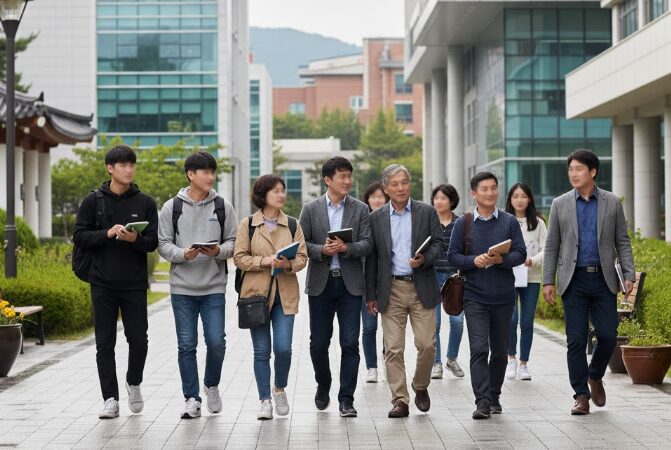
This dynamic began to shift due to two overlapping changes. One was the massification of higher education. As a university degree became universal, higher education began to be viewed not as an institution passed through once in youth but as an educational stage that needed to be accessed repeatedly throughout life. The other was the change in the labor market. As the proportion of regular employment decreased and job transitions became commonplace, the demand for re-education and retraining targeting incumbent workers and middle-aged people rapidly increased.
The government drew universities into the core of lifelong education policy because it needed an institutional space that could absorb these changing demands. Universities already possessed the necessary educational infrastructure, degree-granting authority, and the institutional foundation to provide high-level vocational education. Simultaneously, with the anticipation of a declining school-age population, a pragmatic decision was also made, especially for non-capital region universities, to secure a new demand base.
2008: Introduction of the Lifelong Learning-Oriented University Support Project
Driven by these concerns, the ‘Lifelong Learning-Oriented University Support Project’ was first introduced in 2008. The policy aimed to encourage universities to operate degree and non-degree courses for adult learners and to design academic systems more flexibly. The project was promoted in phases for about nine years, from 2008 to 2016.
The core focus of the initial project was ‘expanding accessibility.’ Policy efforts concentrated on creating separate admission processes for adult learners, expanding night and weekend classes, and making credit recognition and class operation methods more flexible. At the time, the policy design focused on creating pathways to accommodate adult learners within the existing university structure, rather than a fundamental transformation of the university system.
The financial structure also reflected this nature. Until 2011, it applied a method where local governments counter-invested a certain percentage alongside national funding. However, after 2012, mandatory local government counter-investment was transitioned to a recommendation, and instead, the proportion of university self-investment was expanded. While the intention was to enhance university autonomy and responsibility, it also contributed to institutionalizing a structure where lifelong education operated as an ‘additional project’ rather than a core university strategy.
Combination with the Employment First, Education Later (EFEA) Policy
The Lifelong Learning-Oriented University policy soon combined with the Employment First, Education Later (EFEA/ Seonchwiyup Hujinhak) policy, clarifying its direction. The government reinforced the idea that institutional opportunities for obtaining a university degree should be guaranteed to young people who entered employment immediately after high school and incumbent workers.
In this process, the Special Admission Track for Incumbent Workers became a primary policy tool. This track opened a path for high school graduate workers to enter university while requiring academic flexibility to allow the simultaneous pursuit of work and study. University lifelong education policy functioned as the core infrastructure supporting this system. From 2012 to 2014, the ‘Lifelong Learning-Oriented University Support Project’ and the ‘EFEA System Establishment Project’ were pursued in parallel. Later, in 2015, the two projects were integrated and restructured, bundling the entry and sustained learning of adult learners into a single policy framework. This showed that university lifelong education policy had entered a stage of attempting to redesign the higher education entry path itself, beyond merely supporting education programs.
The policies of this period undeniably produced results. University accessibility for adult learners expanded significantly, and an opportunity was created for universities to partially break away from the convention of operating solely for school-age students. It was institutionally confirmed that lifelong education could be one of the university’s roles.
However, the NAFI’s assessment is also clear: the policies of this period were insufficient to change the ‘premise’ of the university system. While systems for adult learners were introduced, the university’s curriculum design, faculty evaluation system, and financial allocation structure still remained centered on the undergraduate system. Adult learners increased but failed to shift into the center of university operations.
This limitation became clearer in the subsequent policy phase. Based on the judgment that simple accessibility expansion was insufficient, the government moved to attempts that directly sought to change the internal organization of universities. The next stage was a matter of ‘expansion and internalization,’ not just ‘introduction.’
College of Lifelong Education and the LiFE Project: ‘Lifelong Education Comes Inside the Organization’ (2015–2024)
By the mid-2010s, university lifelong education policy entered a new phase. Through the Lifelong Learning-Oriented University and EFEA policies promoted since 2008, university access for adult learners had clearly expanded. However, as the policy effects accumulated, the limitations also became clearer.
Adult learners increased, but the university’s operational methods and organizational structure did not significantly change. Lifelong education was still treated as an ‘additional function’ of the existing undergraduate system, and adult learners’ learning experiences often remained a modified version of the school-age student-centered curriculum. The NAFI report defines this period as the ‘stage where pressure for transition accumulated’ in university lifelong education policy. The recognition that merely expanding the entry path for adult learners was insufficient began to spread among both policymakers and universities. The problem was how to establish an educational organization and operating system within the university specifically predicated on adult learners.
The Introduction of the College of Lifelong Education
Driven by these concerns, the ‘College of Lifelong Education Support Project’ was introduced in 2016. Unlike previous policies, this project was significant because it encouraged universities to establish a separate college and dedicated organization for adult learners, rather than absorbing them into the existing departmental system. It was an attempt to make one organizational unit responsible for academic management, curriculum design, and student support for adult learners.
The core of the policy design was clear: the learning style of adult learners differs from that of school-age students, and it was deemed difficult to address this within the same organizational structure. The Colleges of Lifelong Education functioned as an experimental space to institutionally implement adult-friendly academic operations, such as night/weekend classes, intensive course systems, and modular curricula. In some universities, degree programs targeting incumbent workers, middle-aged people, and those seeking career change began to operate in earnest, centered on the College of Lifelong Education.
While the College of Lifelong Education was established within the university organization, its status often remained precarious. It often faced limitations compared to existing colleges in budget allocation, faculty appointments, and academic operational authority, and in many cases, it failed to become a core pillar in the university’s mid-to-long-term development strategy. The organization was created, but structural constraints limited its function as a central organization driving the entire university.
The Emergence and Nationwide Spread of the LiFE Project
Based on this experience, the government moved to systematically expand its university lifelong education policy. The result was the LiFE (Lifelong Education) Project. LiFE was fully launched in its first phase in 2021 and continued into its second phase, establishing itself as the representative brand of university lifelong education policy.
The LiFE Project demanded a comprehensive change for universities to transition to an adult learner-friendly system, going beyond mere program support. Policy goals were set to redesign all aspects of university operation from an adult learner perspective, including admission process, curriculum, academic management, faculty capacity, student support, and regional linkage. The number of participating universities also gradually expanded, encompassing both general and professional universities, not limited to just a few initial institutions.
LiFE participating universities have gradually increased the size of adult learner admissions. Since 2019, the number of admitted adult learners has shown an annual increase, with a notable expansion in the proportion of learners aged 30 and over, and particularly 40 and over. This change, demonstrated by the numbers, indicates the reality that universities can no longer operate solely based on students in their early 20s.
One of the important characteristics of the LiFE Project is that the age distribution of adult learners was concretely revealed through policy effects. According to data, as of the 2023–2024 academic year, the age distribution of new students in LiFE participating universities showed a distinct difference from the existing undergraduate-centric structure. The proportion of learners aged 30 and over occupied a significant level, and in some universities, learners in their 40s and 50s were no longer exceptional cases.
This change holds meaning beyond mere statistics. It signals that universities have begun to face adult learners not as a ‘supplementary target’ but as a structural pillar of actual educational demand. Simultaneously, this acted as pressure for the content and methods of university education to fundamentally change. Adult learners tend to have clear learning objectives, interpret educational content based on their job experience, and seek to connect learning outcomes directly to career changes. This inevitably clashes with the existing theory-centric, school-age student-predicated curriculum.
Despite the expansion of the policy scale and the number of participating universities, many university lifelong education systems still remain in ‘formal operation.’ While adult-friendly academic systems were introduced, limitations repeatedly appeared in actual operation, such as temporal and physical constraints, insufficient linkage between the curriculum and practical work, and limits in customized learning support.
In particular, the issue of faculty involvement remained a core challenge unsolved even after the LiFE Project. Education targeting adult learners tended to be perceived as an additional task for research-focused faculty, and faculty members capable of actively incorporating adult learners’ job experience into the curriculum were not sufficiently secured. Although systems like the industry-academia cooperation-focused professor were introduced, short-term performance-based evaluations and unstable employment structures made the long-term accumulation of educational quality difficult.
The NAFI evaluates this period as the ‘expansion and refinement stage’ of university lifelong education policy, yet diagnoses that it has not reached a systemic transition. The policy became increasingly sophisticated, and the number of participating universities and learners grew. However, the fundamental premise of university operation—the school-age student-centric structure—was not fundamentally shaken. Lifelong education was still managed on a project basis and failed to be redefined as a core university responsibility. At this point, the policy discussion took a turn again. It became clear that the method of continuously ‘adding’ institutions and organizations for adult learners had its limits.
The question raised in the next stage is more fundamental: Should universities maintain the school-age-centric system and append lifelong education, or should they place lifelong education at the center and redesign the function of the university itself?
University Lifelong Education ‘Expanded,’ But Why Did It Not Become a ‘System’? Policies Accumulated, But the University’s Fundamental Premise Remained Unchanged
The university lifelong education policy promoted for over 15 years since 2008 was by no means a disjointed attempt. Starting from the Lifelong Learning-Oriented University Support Project to the EFEA policy, the College of Lifelong Education, and LiFE 1.0 and 2.0, policies have accumulated in stages. The number of participating universities increased, and the entry path for adult learners into universities was institutionally stabilized. The size and age distribution of admitted adult learners also changed, and statistics clearly showed that universities were no longer composed solely of students in their early 20s.
Nevertheless, the NAFI research report assesses that this series of policy trends did not lead to a ‘systemic transition.’ This is not because the policy outcomes were insufficient, but because the gap between the area the policies challenged and the fundamental premise the universities maintained was too large. University lifelong education policy continuously expanded, but the central axis of university operation still remained in the school-age student-centric system.
The university’s curriculum organization, faculty evaluation and promotion standards, financial allocation methods, administrative schedule, and organizational operating structure are all designed under the premise of an undergraduate-centric system. Institutions for adult learners were introduced as ‘additions’ to this system, and consequently, lifelong education failed to break away from the perception of being a managed project rather than a core university function. As policies were repeated, the number of institutions increased, but a level of change in which universities redefined themselves did not occur.
The presented figures clearly show this imbalance. Focused on LiFE participating universities, the size of adult learner admissions steadily increased since 2019, with a notable expansion in the proportion of learners aged 30 and over, and 40 and over. This is an important signal that higher education demand is shifting across the entire lifespan. However, the increase in adult learners did not immediately lead to a redistribution of internal university resources. Despite the expansion of degree programs for adult learners, the faculty manpower and administrative support allocated to these programs were often relatively poor compared to the existing undergraduate system. Dedicated organizations for adult learners existed, but in many cases, they remained on the periphery in terms of budget and authority. This means that adult learners are ‘statistically increasing, but institutionally still in a non-central position.’
Another core limitation that university lifelong education policy repeatedly encountered is the faculty system problem. Education targeting adult learners requires a different educational approach from school-age students. Case-based classes predicated on job experience, problem-solving-centered learning, and flexible evaluation methods are necessary, but this type of education is not easily integrated with the existing research-focused faculty system. The structure in which education for adult learners is perceived as an additional task outside of research is pointed out as a significant problem. In many universities, faculty evaluation and promotion are still centered on research achievements, and lifelong education lectures are often not sufficiently recognized despite their educational contribution. As a result, lifelong education tends to rely on the dedication of individual faculty members, making the accumulation and spread of educational quality structurally difficult.
The system of industry-academia cooperation-focused professors was introduced as an alternative to mitigate this problem, but short-term contracts and performance-based evaluation methods acted as factors restricting the long-term accumulation of educational expertise. Consequently, university lifelong education expanded institutionally, but the faculty group and professional personnel system to sustain it were not sufficiently stabilized.
Financial issues are the point that most directly exposes the structural limitations of university lifelong education policy. Up until now, university lifelong education policies have mostly been promoted in the form of time-limited financial support projects. While institutional introduction and organizational establishment were possible during the project period, structural constraints made it difficult to establish sustainable operating models after the project concluded. According to OECD Education Indicators, South Korea’s public expenditure per student in higher education is not only below the OECD average but also low compared to major developed countries. In this financial environment, it is not easy for universities to attempt a mid-to-long-term transition to an adult learner-centric system. Especially, higher lifelong vocational education targeting adult learners is an area where short-term results are difficult to expect. Curriculum design, accumulation of faculty capacity, and linkage with regional industries are tasks that require mid-to-long-term investment. However, the short-term project-centric financial structure has reinforced the tendency for universities to expend energy on responding to annual evaluations and performance management rather than setting long-term strategies.
The Structural Burden Concentrated on Regional Universities
These limitations did not appear equally in all universities. In particular, non-capital region universities bear a greater structural burden of the university lifelong education policy. Regional universities, where the impact of the declining school-age population appeared first, inevitably had to use adult learners as a new demand base. Still, they had to fully endure the burden of policy experimentation due to limitations in finance, manpower, and regional industrial base. Regional universities were met with the policy expectation of strengthening regional human resource development and industrial linkage through lifelong education, but the stable finance and institutional authority to support this were not sufficiently secured. As a result, lifelong education was emphasized as a ‘survival strategy’ for regional universities but remained in a state of tension without being expanded to a sustainable development strategy.
The reason the NAFI uses the expression ‘transitioning to a lifelong education-centered university system’ at this point is clear. The policy experience so far has shown that the method of appending lifelong education to the existing university system has clear limitations. Adult learners are no longer an exceptional target but are shifting to a structural pillar of higher education demand. Unless the functions and roles of universities are redesigned based on this premise, the policy will inevitably stagnate at the same point repeatedly.
Now, the issue is not whether universities will offer lifelong education. It is the question of which learners the university will center its operation around, and how the curriculum, organization, finance, and faculty system will be restructured based on that choice.
#UniversityLifelongEducation #LifelongLearningOrientedUniversity #EFEAPolicy #LiFEProject #AdultLearner #DecliningStudentPopulation #RegionalUniversity #HigherEducationPolicy #UniversityStructuralTransition #SpotlightU
![[ Conditions of AI Competition ③ ] Does South Korea’s AI Strategy Include Universities?: Where Talent, Universities, and National Strategy Diverge](https://www.spotlightuniv.com/wp-content/uploads/2025/12/20251216_118.png)
![[ Conditions for AI Competition ② ] Universities Are Not at the Center of the AI Era: The World Bank Report Reveals the Structural Crisis of Higher Education](https://www.spotlightuniv.com/wp-content/uploads/2025/12/20251216_117.jpg)
![[ Conditions of AI Competition ① ] The Essence of AI Competition is Not the Model, But Fundamental Strength](https://www.spotlightuniv.com/wp-content/uploads/2025/12/20251216_116.jpg)
![[Analysis] The AI-Driven Labor Market: How Will Universities Respond? – NYU and SUNY’s ‘Experiment of Validation’](https://www.spotlightuniv.com/wp-content/uploads/2026/01/20260118_05-768x411.jpg)
![[The Role of Universities Re-examined Through Lifelong Education ②]The Choice to Center Lifelong Education: Beyond a Survival Strategy for Regional Universities, Toward a Redesign of Future Higher Education](https://www.spotlightuniv.com/wp-content/uploads/2025/12/20251215_106.jpg)


