
This post is also available in:
 한국어 (Korean)
The AI Strategy Exists, But the University is Invisible
As nations adopt AI as a core agenda of their national strategies, the term “National AI Strategy” is no longer unfamiliar. South Korea is no exception. In government documents and policy discourses, the promotion of the AI industry, the nurturing of AI talent, and digital transformation repeatedly appear. However, when applying the critical consciousness of the World Bank’s Digital Progress and Trends Report 2025 to the Korean context, one question naturally arises: What position do universities hold within South Korea’s AI strategy? While universities are clearly mentioned as key entities for talent development, it remains unclear what role they perform at the center of the strategy.
The report defines AI competition as a matter of “fundamental strength” and asks where that strength is accumulated. While connectivity and computing power are relatively clearly defined as realms of national investment and industrial policy, competency and talent are difficult to accumulate without going through universities and the higher education system. Nonetheless, in many countries, AI strategies are designed around industrial promotion and technology adoption, with universities often placed as supplementary means to support those strategies. If this structure persists, AI strategies may yield short-term results, but they will inevitably face limits in long-term capacity building.
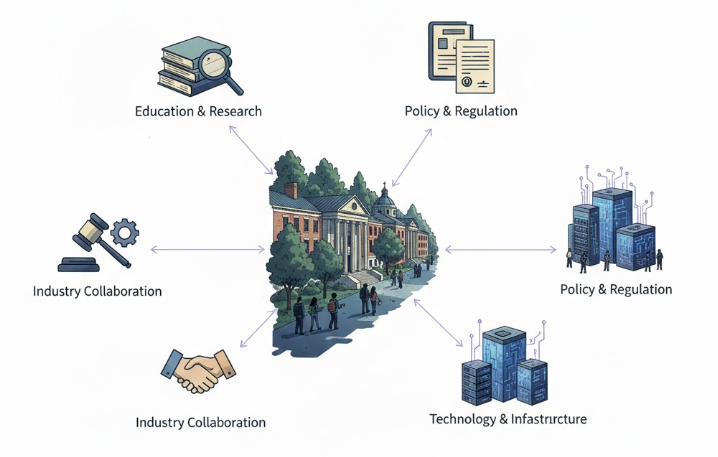
In the report, the World Bank compares the direction of national strategies through the concept of “AI Readiness.” This is not an index evaluating how quickly AI technology was adopted, but rather a question of how well the institutional and human foundations are equipped to continuously utilize and develop AI. Countries with high AI readiness have relatively organic connections between industry, education, research, and policy, with universities functioning as the core link in that connection. In contrast, countries with low readiness tend to pursue technology adoption and talent cultivation in a fragmented, parallel manner.
From this perspective, the way universities are included in an AI strategy is one of the clearest indicators of a nation’s priorities. If universities are perceived merely as labor supply agencies, education and research become subordinate to industrial changes and struggle to perform long-term accumulation functions. Conversely, if universities are recognized as core infrastructure for the AI strategy, issues such as compute accessibility, research environments, and curriculum innovation inevitably become central policy agendas. The question posed by the World Bank report lies exactly here: What does a nation choose as its target for investment, and what does it intend to design structurally in the AI era?
Talent is Cultivated But Does Not Stay: The Other Face of Readiness
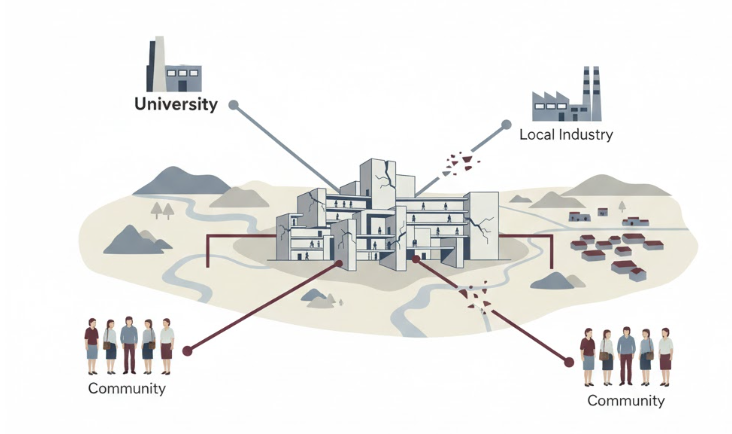
Another core aspect of AI readiness pointed out by the World Bank report is not how many talents are nurtured, but what kind of structure those talents remain within. Many countries set the cultivation of AI talent as a policy goal, but in reality, quite a few lack an ecosystem where that talent can accumulate expertise by moving between research, education, and industry. In such cases, AI talent cultivation exists as a performance metric but does not translate into long-term national capability. The report describes this as the “invisible bottleneck” of the AI era, warning of a structure where brain drain and competency disconnection are repeated.
In this regard, South Korea’s situation is an interesting case to apply the World Bank’s perspective. Recently, the Ministry of Education launched a dedicated task force for AI talent development and began discussing AI ethics and the nurturing of hub universities. This is significant in that it has begun to recognize the AI talent issue as a policy task rather than an individual project. However, this discussion is still focused on “how to cultivate,” and it is difficult to say it encompasses a structure where the cultivated talent accumulates in universities and research sites to nurture the next generation. The AI readiness spoken of by the World Bank poses a higher-level question by including the institutional design for the circulation and accumulation of talent.
The Policy Exists, But is the University at the Center of the Strategy?
Looking more broadly at South Korea’s AI talent policy, AI is being treated as a vital task across education policy. In the Ministry of Education’s 2026 work plan, tasks such as universal AI education, nurturing future AI talent, supporting graduate school innovation and convergent research, and fostering regional universities are presented. This shows that AI is no longer a matter of a specific major or a few talents, but has become an agenda for the entire educational system. Yet, at the same time, this structure reveals that AI is placed as “one of several priority tasks.”
From the World Bank report’s perspective, this is where the question begins. Countries with high AI readiness do not treat AI as a single area of education policy; they reposition it as a central axis that penetrates education, research, and talent policy. In this case, universities are designed as core infrastructure where AI competency is accumulated, not as labor supply agencies. Conversely, if AI is placed in parallel as one of many policy goals, the university remains one of the policy targets rather than the center of the strategy. While the South Korean Ministry of Education’s work plan clarifies the importance of AI talent cultivation, there is still room for interpretation as to whether universities are being redefined as core strongholds of the National AI Strategy. This gap is where the “difference in readiness” spoken of by the World Bank manifests specifically.
The Meaning of Placing Universities at the Center of Strategy
The message repeatedly emphasized by the World Bank report is simple: competitiveness in the AI era is determined by which institutions are placed at the center of the design, not by declarations or individual projects. Placing universities at the center of the AI strategy does not mean establishing a few AI departments or expanding specific projects. It means that the state takes responsibility for designing a structure where universities continuously accumulate AI competency, talent circulates through research and education, and this translates into the capacity of the next generation.
Unless compute accessibility, research environments, curriculum innovation, and long-term talent pathways are tied into a single strategy, universities may remain important institutions but will struggle to be the center of the strategy. From this viewpoint, South Korea’s AI talent policy still has a transitional character. The need for talent cultivation is clearly recognized, and institutional discussions have begun, but it is difficult to conclude that universities are being repositioned as the core infrastructure of the National AI Strategy. Universities are still handled as one of many policy instruments, and the AI strategy is described more strongly in the language of industrial and technological policy. In terms of the World Bank’s AI readiness, this is less a sign of an absent strategy and more a signal that the weight of the strategy has not yet been finalized.
What Kind of University Does South Korea’s AI Strategy Need?
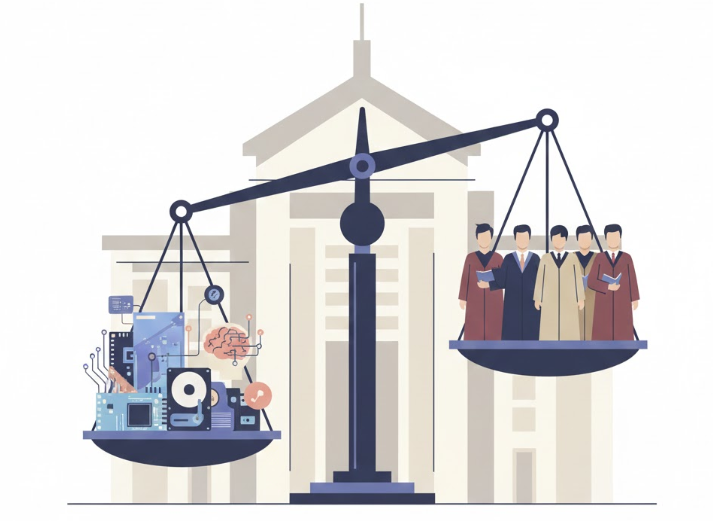
The questions posed by this series ultimately converge into one: Upon what kind of university is South Korea’s AI strategy being designed? Is it a university that merely follows rapidly changing technology, or one that accumulates long-term competency despite the pace of change? Is it an institution that churns out talent, or a space where talent stays and is nurtured again? When the answer to this question becomes clear, AI talent cultivation can finally transcend numbers and projects to become the nation’s fundamental strength.
The World Bank report does not describe the AI competition as a “future that has already begun.” It is a structural competition already in progress, and it serves as a warning that the result will be determined by current choices. Universities do not exist outside of this competition. However, they do not automatically stand at the center either. Depending on where South Korea’s AI strategy places the university, the readiness for the AI era can fundamentally change. The question posed by this series stops here: In the AI era, the question is not what we will adopt more quickly, but what we will design at the center.
Keywords: #SouthKoreaAIStrategy #AITalentDevelopment #UniversityAndNationalStrategy #AIReadiness #HigherEducationPolicy #RoleOfUniversity #NationalAICompetitiveness #WorldBankReport #AITalent #SpotlightU



Leave a Reply