
This post is also available in:
 한국어 (Korean)
Universities Stand Aside from the Center of the AI Era
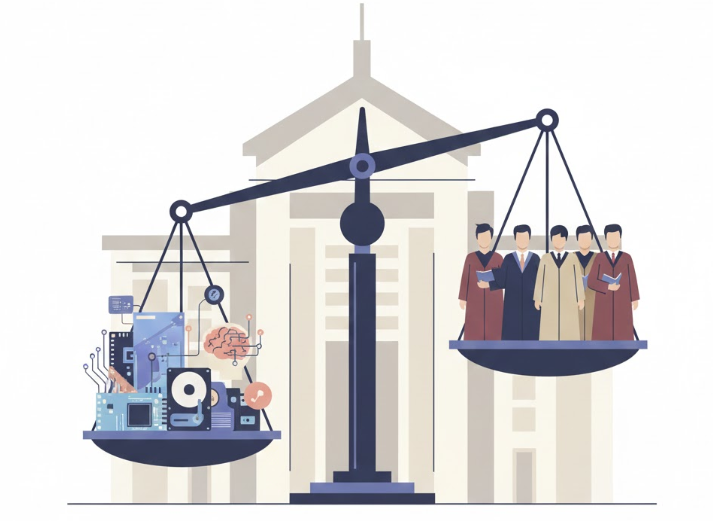
As discussions about the AI era spread, universities are naturally mentioned as if they are at the center of change. This is due to their traditional image as key institutions for talent cultivation and centers for research and knowledge production. However, the reality shown in the World Bank “Digital Progress and Trends Report 2025” is somewhat distant from this common belief. The report’s cold diagnosis is that the space where AI innovation actually takes place is no longer just the university, and in some cases, universities are increasingly moving away from that center. The expectation that universities will automatically become the center in the AI era is close to an assumption that can no longer be presupposed. The report repeatedly points out that the weight of AI research and application is rapidly shifting toward industry. Massive computing resources, vast data, and the financial foundation to operate them stably over the long term are increasingly concentrated in a few global companies and research-intensive organizations. In contrast, many universities are in a structure where it is difficult to meet these conditions. This is not so much a lack of effort or strategy failure by individual universities as it is because the higher education(Higher education) system itself was not designed with the technological conditions of the AI era in mind. As a result, universities face the risk of their role being reduced to a ‘space for following and explaining’ already created technologies, rather than a space for researching and teaching AI.
Why AI Research Is No Longer Born in Universities
Another important observation presented by the World Bank report is the fact that cutting-edge AI research is increasingly moving to the outskirts of the academic community. In the past, there was a relatively clear structure where universities produced new theories and technologies, and industry commercialized them. However, this dynamic is rapidly collapsing in the AI field. Developing the latest AI models requires enormous computing power and continuous data accumulation, conditions that many universities find difficult to handle. Consequently, the starting point of AI research is increasingly shifting to corporate laboratories and large-scale technology platforms. This change means more than just a shift in research subjects; it signifies a change in the way knowledge is produced itself. As research topics become more strongly dependent on corporate strategy and market logic, the space for long-term and critical research that universities have performed shrinks. Simultaneously, there is a growing possibility that students will be educated as ‘users who use pre-determined tools’ rather than ‘entities who understand and design’ AI. The World Bank points out at this point that for universities to maintain their role in talent cultivation in the AI era, a structural transformation is needed beyond the level of simply adding AI subjects to the curriculum. Otherwise, universities are highly likely to position themselves as institutions that consume results at the periphery rather than being at the center of AI innovation.
The Time of AI and the Time of Universities Have Begun to Misalign
The most fundamental vulnerability of universities pointed out by the World Bank report lies in a structure that cannot keep up with the speed of technological change. AI technology sees new models and usage methods emerge every few months, but university curricula are designed based on reorganization cycles spanning several years. Curriculum reform must go through internal department discussions, academic restructuring, faculty placement, and administrative procedures, a process that inevitably takes time. As a result, by the time AI technology is fully applied to industry and society, university educational content often starts a step behind. According to the report, this time lag is particularly pronounced in universities in low- and middle-income countries. In some regions, a significant number of universities have not reorganized their information and communication technology(ICT) related curricula for more than five years, and the educational infrastructure capable of handling AI or data science at a major level is extremely limited. This does not simply mean an educational vacuum in a specific field. In a situation where AI is increasingly permeating various majors and job functions, the stagnation of the curriculum leads to the entire higher education system becoming disconnected from reality. While university degrees still function as social signals, the competencies contained within them are moving further away from the demands of the labor market.
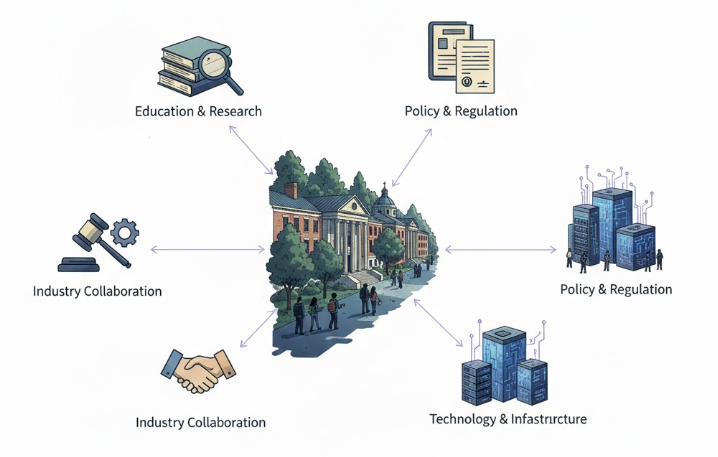
Explaining these problems solely through the incompetence or conservatism of individual universities is not accurate. The World Bank report emphasizes that the institutional environment to which universities belong was not designed for the AI era. In many countries, higher education has developed as a system that emphasizes stability and equity, which has resulted in a structure that prioritizes predictability and procedural consistency over rapid change. While these characteristics were advantageous for long-term academic development, they are acting as constraints in the AI era, where technological change has accelerated extremely. In particular, financial structures and personnel management methods greatly limit the responsiveness of universities. AI education and research require expensive computing resources and professional personnel, but many universities do not have the authority to secure these autonomously or redeploy them flexibly. In a situation where faculty hiring, research investment, and curriculum reform are tied to national-level regulations and financial distribution structures, it is not easy for universities to respond nimbly to industrial changes. The World Bank points out that at this point, there is a need to view the limitations of universities not as a matter of individual choice or organizational culture, but as a problem of the entire policy and institutional environment surrounding higher education.
AI Education Is Already Being Reorganized Outside of Universities
The World Bank report clearly shows that the main pathways for AI competency formation no longer stay only within universities. Online education platforms, short-term intensive training courses, and corporate-led retraining programs are expanding rapidly to keep pace with the speed of AI technological change. The common denominator of these educational methods is flexibility and immediacy. When a new technology emerges, courses are opened within months, and practical tasks are immediately reflected in the educational content. While universities spend time within institutional procedures and academic structures, a significant portion of AI education is already being supplied through other channels. According to the report, the number of courses and learners related to Generative AI has exploded in recent years. Particularly, office workers and learners seeking career transitions tend to choose short-term and modular education instead of degree programs. This is a matter of cost and time, but above all, it is because the external education market is supplementing the ‘currency’ that university education fails to provide. In a situation where AI technology changes rapidly, learning paths that provide immediately applicable competencies are operating more attractively than education predicated on graduation several years later.
These changes do not immediately collapse the social status of universities. University degrees still function as important signals in the labor market, and the role of universities as a space for research and knowledge accumulation has not disappeared. However, the World Bank diagnoses this state not as ‘stability’ but as something closer to ‘delayed change.’ It means a dual structure is becoming entrenched where degrees are maintained, but the space where competencies are actually formed is increasingly moving outside of universities. In this process, universities are placed in an increasingly contradictory position. On the one hand, they are required to cultivate talent for the AI era, while on the other, they are giving up their core educational functions to the external market. This is not just a matter of competition, but leads to questions about the identity of higher education. If universities are no longer the center of technological competency formation, they cannot avoid the question of what they should teach and what role they should perform in the AI era. The World Bank report does not provide a clear answer to this question, but it at least makes it clear that it is difficult to maintain the centrality of universities through the continuation of existing methods alone.

The Reason Why Universities Are Not Completely Replaced Nonetheless
The World Bank report also makes it clear that despite AI education and research expanding rapidly outside of universities, universities cannot be completely replaced. This is because universities are not mere technology transfer institutions, but systems that systematize, verify, and accumulate knowledge over the long term. AI technology also gains public meaning only when it is combined with ethics, social impact, and institutional responsibility, rather than remaining a mere set of algorithms and tools. In dealing with these issues, universities are still among the few spaces that can perform an irreplaceable role. Furthermore, as AI technology enters a mature stage, the importance of foundational studies, critical thinking, and interdisciplinary understanding becomes even greater than short-term technical skills. The World Bank emphasizes as core competencies for the AI era not only simple coding or tool utilization skills, but also the ability to define problems, interpret context, and recognize the limits of technology. These are elements that are difficult to provide sufficiently through short-term educational programs or in-house corporate training alone. In this regard, universities are still necessary institutions in the AI era, and the problem lies not in the existence of the university itself, but in how to redefine its role.
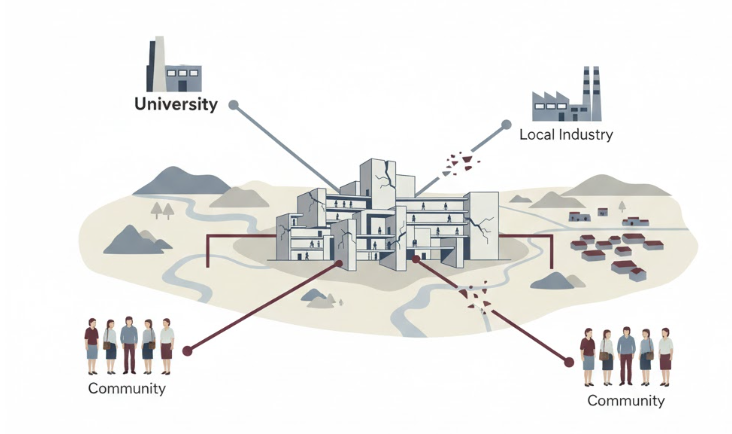
However, the report simultaneously throws a clear warning. If universities fail to redefine their own roles, their importance is more likely to gradually shrink rather than be maintained. In a situation where the center of AI education moves outward and the front lines of research shift to industry, if universities stick to existing structures and speeds, key decisions in the AI era will inevitably be made outside of universities. This does not mean that universities will disappear, but rather that they will be reorganized into institutions with a limited scope of influence. The crisis of universities shown by the World Bank report is a matter of long-term positioning rather than short-term status. For universities to remain at the center of the AI era, they must move beyond the level of ‘introducing’ technology and redesign the structure of education, research, and talent cultivation itself. Otherwise, universities are highly likely to remain as institutions that belatedly explain already determined flows, rather than institutions that interpret the AI era. This question goes beyond the choice of individual universities and is directly linked to strategies at the national level. In the next installment, we expand the question at this very point: In the AI era, where will the state position universities and what roles will it assign them?
#AI and universities #Higher education crisis #AI education #University crisis #AI research #Online education #AI talent #World Bank report #Future of universities #SpotlightU


Leave a Reply