
![[Analysis] The AI-Driven Labor Market: How Will Universities Respond? – NYU and SUNY’s ‘Experiment of Validation’](https://www.spotlightuniv.com/wp-content/uploads/2026/01/20260118_05-300x161.jpg)
![[Review] Netflix’s “Can This Love Be Translated?”: The Most Beautiful Way to Correct the Heart’s Mistranslation](https://www.spotlightuniv.com/wp-content/uploads/2026/01/20260118_03-300x207.jpg)
![[Review] Materialists: A Relationship Analysis Report Disguised as a Romantic Comedy](https://www.spotlightuniv.com/wp-content/uploads/2026/01/20260115_17-300x196.jpg)
This post is also available in:
 한국어 (Korean)
13 Departments Participate in Experiments Ranging from Urban Diagnosis to Care and Culture… Presenting a Citizen-Centric Innovation Model
The strategy of co-designing with citizens, rather than limiting the agency of local problem-solving to universities or administrations, is emerging as a core strategy for regional innovation. Pusan National University (PNU) is translating this approach into tangible results by operating “Citizen-Participatory Living Labs” through the Regional Innovation System & Education (RISE) project.
On December 19, Pusan National University held the “RISE Citizen-Centric Living Lab Achievement Sharing Meeting” at the Centum Hotel in Haeundae, Busan. During the event, the university shared the progress and future directions of the project titled “Building a Citizen-Centric Innovation Milieu for Solving Community Problems.” The gathering was organized to comprehensively summarize the Living Lab activities promoted as part of the RISE project and to discuss possibilities for regional expansion.
A total of 13 departments and graduate schools within PNU participated in the project, including: Geography Education, Music, History, Language and Information, Art, Culture and Image, Design, Urban Engineering, Public Administration, Interior Environmental Design, Biomedical Convergence Engineering, Food and Resource Economics, Media and Communication, and the Graduate School of International Studies. Based on the expertise of each academic field, various practical outcomes were derived, such as urban space analysis, regional diagnosis, interpretation of historical and cultural resources, data-driven analysis, cultural and artistic content production, public design and space planning, policy proposals, and health/care connection models.
Through these Living Labs, PNU has approached complex local issues facing Busan—such as youth outflow, population aging, urban decay, cultural alienation, and future social changes—in a citizen-centric manner. A key feature of this initiative is that it moved away from the traditional method where researchers define problems, instead designing a structure where citizens and students jointly identify and experiment with solutions.
During the achievement sharing meeting, a “Contest-Linked Living Lab Project,” in which students and citizens teamed up, was introduced as a major case study. Through hackathons and on-site mentoring, the participating teams presented results on various topics, including regional space improvement, a “Busan-style Aging in Place” model, big data utilization for future society, and citizen-proposed local issues. These were evaluated as cases demonstrating that citizen-participatory problem-solving models can possess actual applicability in policy and field settings.
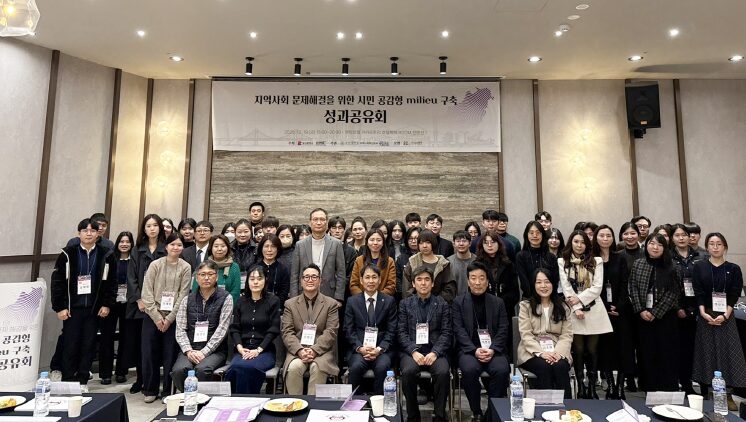
Kim Hyung-nam, Director of Planning at PNU (Head of the Community Innovation Headquarters), stated that this project is highly significant because it established a structure where students, citizens, and local agencies jointly define and experiment with problems, rather than the university unilaterally solving local issues. He explained that PNU will continue to expand the citizen-centric regional innovation model based on the accumulated achievements.
Park Sang-hoo, Vice President for External and Strategic Affairs at PNU (Director of the RISE Project Group), also assessed the event as a showcase of how university research and education achievements can lead to substantial changes in citizens’ lives and local fields. He added that as a national university growing alongside the region, PNU will continue to contribute actively to solving community problems. Following this achievement sharing meeting, Pusan National University plans to further refine its citizen-participatory Living Lab model and continuously develop a community cooperation platform centered on the RISE project.
#PusanNationalUniversity #RISEProject #CitizenParticipatoryLivingLab #RegionalInnovation #CommunityProblemSolving #UniversityRegionalCooperation #PublicDesign #UrbanInnovation #CitizenCentricModel #NationalUniversity #SpotlightU