


![[Analysis] The AI-Driven Labor Market: How Will Universities Respond? – NYU and SUNY’s ‘Experiment of Validation’](https://www.spotlightuniv.com/wp-content/uploads/2026/01/20260118_05-300x161.jpg)
![[Review] Netflix’s “Can This Love Be Translated?”: The Most Beautiful Way to Correct the Heart’s Mistranslation](https://www.spotlightuniv.com/wp-content/uploads/2026/01/20260118_03-300x207.jpg)
![[Review] Materialists: A Relationship Analysis Report Disguised as a Romantic Comedy](https://www.spotlightuniv.com/wp-content/uploads/2026/01/20260115_17-300x196.jpg)
This post is also available in:
 한국어 (Korean)
Can the Glocal University Policy Be the Solution for Korean Higher Education?
Regional extinction is no longer an abstract future problem. Depopulation and aging have become everyday conditions for local communities, and universities stand at the center of this shift. A decline in students threatens the existence of universities, and the weakening of universities, in turn, leads to regional decay. In this vicious cycle, universities are sometimes identified as the cause of the problem and other times called upon as the key to the solution.
In recent years, “region” and “university” have almost always been mentioned together in Korean higher education policy. Concepts like Glocal University, regional innovation platforms, and university-local government cooperation models symbolize this trend. Yet, questions remain: What role should universities play to save the regions, and is that role possible within the current university structure?
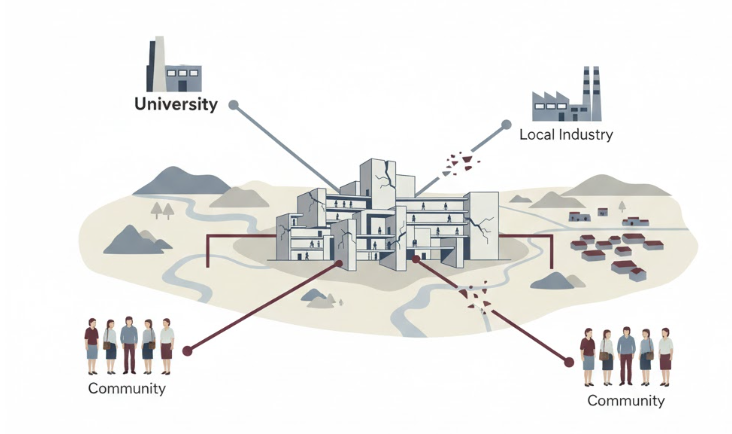
The crisis of regional universities is often simplified as a matter of educational quality—the familiar explanation being that they are struggling because student numbers are down and competitiveness has dropped. However, this only reveals part of the problem. The hardship of regional universities is a structural issue rather than an educational one. For a long time, Korea’s higher education system has been designed with a focus on the Seoul Metropolitan Area. Research resources, talent, corporations, and jobs have concentrated there, and universities have been subordinate to this flow. Regional universities were required to compete under the same criteria as Seoul-based universities rather than performing roles suited to regional needs.
Consequently, instead of developing unique functions, regional universities have been forced to seek survival within disadvantageous competition. In this structure, it is difficult for regional universities to become subjects of regional development. While roles like linking with local industries and solving regional problems were emphasized politically, the actual evaluation and financial structures(higher education financial structure) did not sufficiently support them.
Redefining the Role of Regional Universities: Beyond Mere ‘Survival’
The Glocal University policy emerged from this structural awareness. The idea of redesigning regional universities as core hubs of regional innovation, rather than mere objects of maintenance, is a distinctly different approach. The vision of creating a structure where local governments, industries, and research institutes combine around a university is an attempt to link regional policy with higher education policy.

Universities are critical to regional innovation because they are nearly the only institutions capable of nurturing talent, producing knowledge, and accumulating regional capacity over the long term. Corporations can move and industries can change, but a university is a fixed regional asset. The problem is whether universities are designed to perform this role. Current structures are still organized around academic units and majors and do not evaluate regional problem-solving as a core performance metric.
Discussion on saving regional universities often boils down to whether to reduce the number of universities or cut quotas. However, this assumes all universities must follow the same model. The important thing is not the number of universities, but their role. Regional universities do not need to perform the same roles as those in Seoul. Their reason for existence becomes clear when they perform functions suited to local industry, society, and population structures—such as vocational education, lifelong learning, regional problem-solving research, and career path design for local youth.
Structural Obstacles: Finance, Time, and the Youth Path
1. If the financial structure doesn’t change, the role won’t change. The financial structure of Korean higher education has functioned to strengthen ranking competition. Allocating funds based on performance compared under identical indicators has induced convergence rather than diversity. Functions like regional industry linkage are difficult to translate into short-term visible results. As a result, a paradox occurs where the more a regional university contributes to regional innovation, the more disadvantaged it becomes under existing evaluation systems.
2. Regional innovation time vs. University time. Regional innovation takes time—time to build industrial foundations and form trust with the community. Conversely, policies often demand results in short cycles. If policies are designed around short-term outcomes, universities focus on short-term projects rather than sustainable structural shifts. When the policy ends, the results often vanish.
3. No innovation is sustainable without youth retention. No matter how many roles a regional university performs, if the youth educated there leave the region, innovation cannot be sustained. Local talent retention(local talent retention) is both a result and a condition of regional innovation. As explored in previous installments, youth migration is deeply linked to career path instability. For youth to stay, their post-learning paths must be designed within the region, which requires coordination with employment, housing, and industrial policies.
The Meaning of ‘Glocal’: Breaking the Dichotomy
The word “Glocal” contains both regionality and globality. In reality, these are often separated: there is a perception that universities solving regional problems lag behind in global competition, while those performing world-class research are distant from their regions.
The Glocal University concept is an attempt to overcome this dichotomy. It requires a university to be rooted in its region while interpreting and solving regional problems within a global context. This is not a choice to lower the quality of research, but a choice to expand its direction. Success depends on whether this shift in perspective—recognizing that a university for the region is not one disconnected from the world—is reflected in institutions, evaluations, and finance.
Conclusion: A Choice for the Future
Korean higher education stands before the question of how to view regional universities: as objects of maintenance or objects of redesign. The Glocal University policy is an attempt at an answer. However, the completion of this answer depends on structural change. Redefining roles, shifting financial structures, and reforming evaluation systems must occur simultaneously.
While Glocal Universities and regional innovation are one axis of structural reform, another axis is moving the structure: educational methods, evaluation, and governance. The spread of AI and digital technology is forcing us to question the very premises of university operations and education.
In the next installment, we will examine under what conditions the structural transition of Korean higher education can be completed, focusing on AI/Digital Transformation and Education Governance.
#GlocalUniversity #RegionalUniversity #RegionalInnovation #HigherEducation #UniversityReform #UniversityStructure #RegionalExtinction #EducationPolicy #SpotlightU
![[ Conditions of AI Competition ③ ] Does South Korea’s AI Strategy Include Universities?: Where Talent, Universities, and National Strategy Diverge](https://www.spotlightuniv.com/wp-content/uploads/2025/12/20251216_118.png)
![[ Conditions for AI Competition ② ] Universities Are Not at the Center of the AI Era: The World Bank Report Reveals the Structural Crisis of Higher Education](https://www.spotlightuniv.com/wp-content/uploads/2025/12/20251216_117.jpg)
![[ Conditions of AI Competition ① ] The Essence of AI Competition is Not the Model, But Fundamental Strength](https://www.spotlightuniv.com/wp-content/uploads/2025/12/20251216_116.jpg)

![[OECD Analysis] Korean Education 2025 – Questioning the System Beyond Achievement ① : A Nation at the Peak of Success, Universities Driven into Instability](https://www.spotlightuniv.com/wp-content/uploads/2025/12/20251215_107-768x434.png)