
This post is also available in:
 한국어 (Korean)
Students Tackle Local Business Issues: From Planning to On-Site Validation
As university education increasingly shifts toward solving real-world community issues, students at Chonnam National University (CNU) Department of Business Administration have launched a practical project aimed at revitalizing local commercial districts. This case serves as an experiment in regional change, where students led the entire process—from research and planning to on-site application—moving beyond traditional theory-centered lectures.
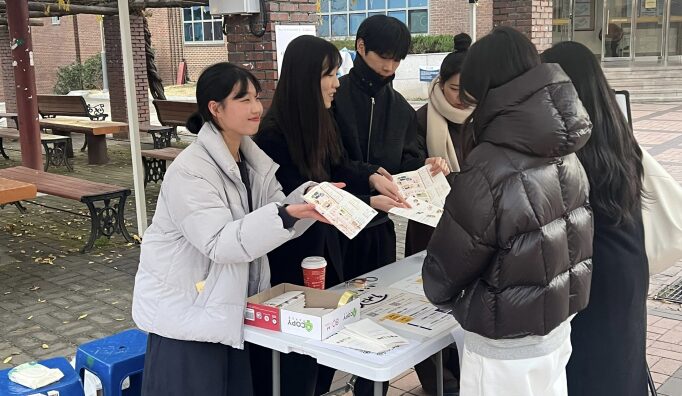
According to Chonnam National University, business students designed and operated ‘It-Da-Ing’ (Connecting), a project to revitalize the Yongbong-jigu commercial area as part of the Regional Innovation System & Education (RISE) project. Students introduced their project results through an on-campus promotional booth, attempting an experimental link between the local business district and the university community. Conducted under the guidance of Professor Han Byeong-seop, the project was designed as an educational model to apply major theories to field problem-solving.
Strategy: Bridging Psychological Distance Through “Course Packages”
The students first conducted a survey among CNU students to analyze perceptions, visiting experiences, and consumption patterns regarding the Yongbong-jigu district. The results revealed that while geographically close, the area was perceived as having poor walking accessibility, a lack of store information, and a strong image as an entertainment-focused (nightlife) district. The students identified this perception as the primary barrier to frequenting the area.
In response, the ‘It-Da-Ing’ team developed a “Course-type Package” strategy to simultaneously address the information gap and psychological distance. Rather than promoting individual stores, they curated day and night courses linking cafes and dining spaces to increase “stay time” and naturally expand consumption routes. Students personally visited stores to conduct interviews and checklist evaluations, selecting participating businesses based on price range, atmosphere, accessibility, and intent to revisit.
During the design process, theories from major courses—such as Marketing, Consumer Behavior, and Industrial Analysis—were directly integrated into the planning structure. Professor Han Byeong-seop participated throughout the project, refining the design to ensure that theories functioned effectively in the field rather than remaining mere academic explanations. This allowed students to experience the actual process of solving commercial issues rather than just submitting proposals.
From Classroom Theory to Regional Symbiosis
The completed ‘It-Da-Ing’ packages were introduced to the student body through an offline promotional booth on campus. The booth featured interactive content, such as sticker-based participation and pre-registration programs, to drive interest. Through this, students confirmed real-world reactions to their plans and tested the feasibility of their revitalization strategies.
Chonnam National University evaluated this case as a successful confirmation of the potential for major-based practical education and regional win-win models. The university explained that the project was significant because it demonstrated that theories learned in the classroom can serve as tools for solving regional problems, creating a collaborative structure connecting students, the university, and local merchants. The CNU Department of Business Administration plans to continue expanding such regional cooperation projects in connection with future RISE initiatives.
#ChonnamNationalUniversity #RISEProject #LocalBusinessRevitalization #UniversityRegionalCooperation #PracticalEducation #StudentLedProject #BusinessAdministration #Yongbongjigu #UniversityInnovation #RegionalProblemSolving


Leave a Reply