
This post is also available in:
 한국어 (Korean)
In 2026, the University is No Longer the University of the Past
The higher education environment in 2026 stands at a turning point where the ‘operating principle of learning’ itself is changing, moving beyond traditional education systems. The competitiveness of a university is determined not merely by its educational programs or campus infrastructure, but by how quickly and accurately it absorbs global technological, economic, and geopolitical shifts. Especially as international uncertainty dramatically expands between 2025 and 2026, universities are being pressed to ‘redefine their roles’ at a speed faster than ever before. Educational institutions are transforming from places that transmit knowledge into intellectual platforms that define problems and construct new solutions, and into core hubs of a data- and AI-driven society.
Key signals explaining this trend repeatedly appear in reports from various global organizations. The Udemy 2026 Global Learning & Skills Trends Report analyzes that “the introduction of AI technology has entered a phase of restructuring the entire operational method (OS) of the organization, going beyond the individual learner’s challenges.” This is not just a matter of innovation in teaching methods using AI or automated administrative systems, but a diagnosis that the university’s entire value chain is inevitably being rearranged around AI. Indeed, many global corporations and institutions are completely overhauling their employees’ roles, evaluations, and learning structures following the introduction of AI, and this change exerts the same pressure on universities. Following this, The Economist’s “Ten Trends to Watch in 2026” more directly points to the changes in the international environment. This report discusses policy uncertainty in the second year of the Trump administration, the US-China strategic competition, pressure for increased defense spending in Europe, and instability in the global supply chain, diagnosing that “2026 will be a period where the rules-based international order is shaken.” This trend influences higher education, as student mobility, international joint research, education finance, and the academic ecosystem have all become sensitive to geopolitical variables. In short, the transformation of the university in 2026 cannot be explained merely as an educational theory problem; it must be viewed as a ‘total transition’ intertwined with technology, politics, economy, and society.
Thus, higher education in 2026 operates under entirely different conditions than before. The question universities now face is simple: “In an era where AI and global risk are normalized, what must the university do more of, and what must it discard?” The next section will seriously examine how AI Fluency, the core pillar of this structural change, determines university competitiveness.
AI Fluency — The New Standard for University Competitiveness in 2026
The way AI is changing higher education is no longer at the level of simple digital tool or automation program adoption. The hallmark of 2026 is that AI has begun to become the university’s “Operating System.” Specifically, the Udemy report defines AI Fluency not as an extension of literacy, but as the ability for the entire organization to interact with AI and achieve its goals. The important thing is not “Do you know how to use AI?” but “Have you changed your organizational structure and culture to be able to work with AI?” That is, an era is opening where the maturity of the university’s entire operating system, rather than individual technical competence, determines competitiveness.
This trend provides clear implications for Korean universities. Until now, many universities have implemented ChatGPT, expanded AI general education courses, and conducted AI training for faculty and staff. However, these are closer to measures at the ‘literacy’ level, enhancing the individual learner’s function. By the standard of AI Fluency, such measures are only the initial stage of university competitiveness. True competitiveness is realized when the redesign of AI-based information flow, automation of administrative procedures, redefinition of roles for faculty, staff, and students, and data-driven policy decision-making are combined. In other words, AI Fluency aims to transform the university organization into a type of Intelligent System.
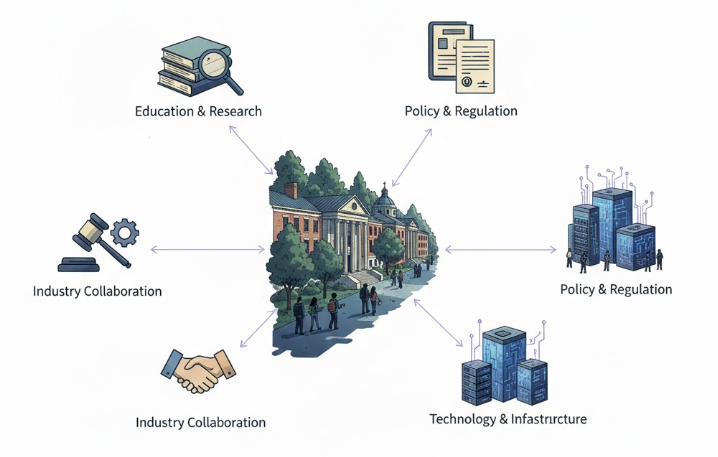
Furthermore, the emergence of Agentic AI accelerates this change. Agent-type AI goes beyond simple Q&A to act based on goals, autonomously performing complex tasks. Many areas, including university administration, academic affairs management, research data analysis, and student counseling, are likely to be reorganized around agents. This changes the role of university members itself; routine tasks of the past will be performed by AI, while humans must focus on creative, strategic, and interpersonal functions. This reorganization is a trend already rapidly progressing in global corporations, and educational institutions are no exception.
Collapse of the Classroom-Centric Structure and the Spread of ‘Flow-of-Work Learning’
As AI begins to permeate the university’s operating system, the first areas to shake are the form of the classroom and the flow of learning. The traditional classroom has long functioned as a stable space for knowledge transmission, but in 2026, its structural foundation is gradually weakening. The linear learning model of “professor’s explanation $\rightarrow$ student’s note-taking $\rightarrow$ exam evaluation” no longer provides sufficient value to the learner. The reason is simple: students today do not obtain knowledge in the classroom. AI-based summarization, tutoring, and problem-solving tools already largely replace that role.
The representative concept explaining this change is the Flow-of-Work Learning emphasized in the Udemy report. This report explains that the proportion of learning that occurs within the context of actual work or projects, moving away from traditional theory-centric education, is rapidly increasing. Students no longer ‘study to know.’ They prefer ‘learning for immediate application,’ and universities must redesign their educational structure accordingly. For example, AI-based code analysis tools that provide real-time feedback, process analysis AI that automatically tracks students’ problem-solving processes, and virtual simulation-based experimental environments are already being adopted by many global universities.
This trend changes the format of the curriculum itself. Previously, courses were fixed and operated on a semester basis, but after 2026, universities are significantly expanding short modular courses, project-based learning, and corporate-collaborative practical assignments. As the purpose of the lecture shifts from ‘knowledge transmission’ to ‘practical competence building,’ the university’s role is also reorganized from “an institution that provides the correct answers” to “a platform that guides the way to solve problems.” Naturally, the role of the professor also changes. The professor moves from lecturer to coach, designer, and evaluator, and the student changes from a passive recipient of knowledge to an active learning subject who structures and executes.
The Evolution of Assessment — Shifting from Problem-Solving Ability to ‘Execution Competence’
As the curriculum is reorganized around practical application, the assessment method is inevitably changing as well. In an era where AI can perform summarization, organization, and problem-solving of almost all knowledge to a certain level, the existing correct-answer type assessment no longer serves as an indicator for measuring a learner’s competence. The challenge facing universities in 2026 is the question: “What should be assessed, and how?” This demands a reconstruction of the ‘perspective on competence’ itself, not just a change in exam format.
The Udemy report explains the core of this change as Performance-based Assessment. Actual problem-solving processes, consistency of decision-making, interpretation of input data, and contribution in collaboration processes are emerging as new assessment factors, and AI functions as a tool to record and analyze this process data. For instance, if the entire process of how a student searched for materials, what choices they made, and how they failed or succeeded in solving a problem is automatically recorded, the university can assess the learner’s thinking structure and execution competence, not just the simple result.
Moreover, AI-based automated grading and text analysis tools reduce the feedback burden on professors, increase the consistency of evaluation, and enable a new method of data accumulation that can track the growth of individual students. This both improves the quality of education and forms the foundation for universities to cultivate the ‘actionable talent’ demanded by the industry. Especially aligning with the trend of global companies increasing their preference for performance-oriented talent, the change in university assessment methods is becoming a survival strategy, not an option
The Shock Brought by Geopolitical Risk — Changes in Student Mobility, International Cooperation, and Research Environment
When discussing higher education in 2026, geopolitical environmental change is a factor as crucial as AI. The Economist’s 2026 forecast suggests that strategic tensions will continue to escalate among the US, China, and Europe, and the world is likely to move toward an order centered on transactional, short-term interests rather than a stable normative framework. This change affects not only diplomatic or security issues but also creates deep fissures in the higher education ecosystem.
The first change to appear is the fluctuation in international student mobility. Stricter immigration policies in the US, China’s domestic industry protection policies, and economic burdens in Europe influence the choices of international students. Korea is also not exempt from this trend. As the competitiveness of higher education in the Asian region continuously rises, the attractiveness of Korean universities is being relatively re-evaluated, and at the same time, Korean universities must seek new educational and research partnership models considering global uncertainties. In particular, academic fields related to industries under strong geopolitical pressure, such as STEM fields or semiconductors, energy, and bio-tech, may face restricted or enhanced cooperation depending on national strategy.
The second change is the shift in international joint research and research funding flows. With the reorganization of the supply chain and intensifying national competition centered on strategic industries like semiconductors, batteries, and energy, research funds tend to be increasingly coupled with specific industries and national strategies. This means that universities must consider not only market changes but also the balance of power between nations and the diplomatic environment when establishing research strategies. The trend of narrowing the scope of research freedom and international cooperation is likely to have a significant long-term impact on the STEM research ecosystem in Korean universities.
Redesigning the Student Experience — The Era of Mental Health, Stability, and Preparedness
The key keywords defining the Student Experience in 2026 are Stability and Preparedness. All trend reports from global research institutions between 2024 and 2026 commonly point out that the daily stress level of young people has sharply increased since the pandemic. Euromonitor’s 「2026 Consumer Trends」 presents an analysis that 58% of global consumers responded that “daily stress seriously affects their lives.” This is not merely a consumption trend but an important indicator of how universities must support students. Learning is effective only on a stable emotional foundation, and if anxiety and pressure persist, not only learning efficiency but also the health of the entire university community is shaken.
In this situation, what students seek is not stimulating experiences or competitive structures, but rather “quiet and clear stability and predictability.” Euromonitor names this the Comfort Zone trend, interpreting it as spreading across the consumption behavior and entire lives of the younger generation. Universities are no exception to this trend. All areas, including student counseling centers, dormitory living environments, academic calendar operation, and curriculum structure, are being realigned with the goal of “an environment where students can learn safely and with a sense of control.” Beyond simply operating stress management programs, a structure is emerging where the university comprehensively analyzes students’ learning pathways and emotional states to provide personalized stability strategies.
This change has led to viewing mental health support not as “welfare” but as a core component of “learning capacity enhancement.” Universities in 2026 no longer provide mere counseling to students requesting depression or anxiety support. They measure and improve students’ daily patterns in diverse ways, such as AI-based stress analysis tools, sleep and activity tracking services, and personalized Recovery Frameworks. This aligns with the Health Intelligence HQ (data-based health intelligence) trend mentioned in Trend Korea 2026. Ultimately, the student experience is moving away from a ‘counseling-room-centric service’ to a system where daily health data determines the quality of learning. It has become an era where university competitiveness is evaluated not by students’ grades, but by the university’s ability to create the “conditions for healthy growth” of its students.

The Survival Strategy for Korean Universities in 2026 — What to Discard and What to Add
The crisis facing Korean universities in 2026 is not merely the problem of a declining school-age population. With the acceleration of AI technology, global geopolitical risks, and changes in Gen Z’s learning and consumption patterns all overlapping, universities have reached a structure where maintaining competitiveness without strategic redesign is difficult. So, what strategy should universities adopt in 2026?
Reconstruction of the AI-based University Operating System. Expanding AI literacy education is not enough. As the Udemy analysis suggests, AI Fluency means “a state where the organization’s mode of operation is naturally connected with AI.” For this, a total transition is necessary to redesign all university functions—academic affairs, administration, research, counseling, and career development—to be AI-friendly. For instance, the Faculty Support Center should evolve beyond merely helping professors produce educational content to a platform equipped with AI-based achievement analysis, automated lecture design, and personalized learning path construction features. In the administrative domain, strategic functions are required, such as predictive analysis-based detection of student dropout risk, tracking of prospective graduates, and Q&A automation, beyond just the automation of routine tasks.
2. Innovation in Assessment and Expansion of Practical Learning. Companies no longer judge talent based on “good grades.” The industry in 2026 evaluates problem-solving ability, collaboration competence, and judgment ability in the actual execution process as the core of talent. For universities to meet these demands, they must reduce exam-centric assessment and strengthen practice-centric performance structures, such as practical projects, portfolio-based assessment, and long-term problem-solving assignments. AI can function as a tool to record and analyze students’ thinking patterns and execution processes in this context.
3.Reorganization of International Strategy Considering Geopolitical Risk. The 2026 outlook presented by The Economist suggests that the international order will be reorganized around ‘volatility’ rather than ‘predictability.’ This implies that Korean universities cannot rely solely on existing North America- and Europe-centric international cooperation. They must build cooperation networks with regions showing high growth potential, such as Southeast Asia, the Middle East, India, and Africa, and diversify cooperation models into fields less affected by political fluctuations (e.g., joint online education, remote joint projects, industry-collaboration based programs).
4.Redesign of the Student Experience. Gen Z does not simply want a degree from a university. They want a ‘holistic learning experience’ that provides a clear growth path, mental stability, personalized support, and continuous feedback. For this, the university needs a design that integrates counseling, health, learning, and career services based on data and improves the quality of student life. Ultimately, it has become an era where university competitiveness is evaluated not by the size of the department or campus, but by the question of “Can the student feel safe and growing at this university?”
The Raison d’être of the University Must Be Redefined
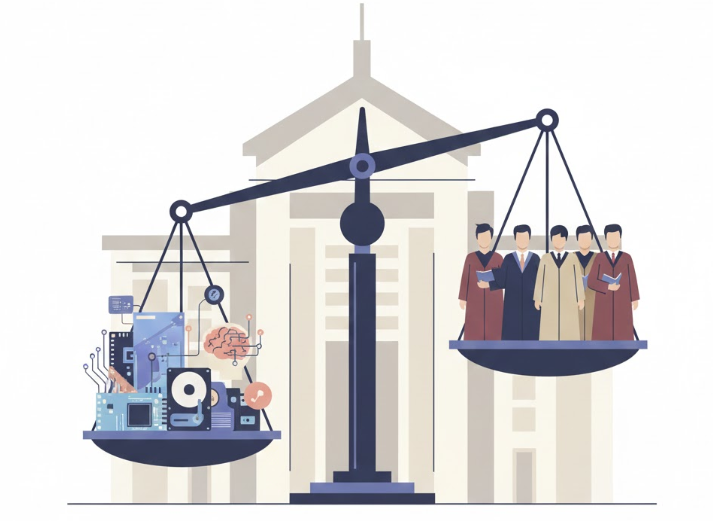
2026 is the year the future of higher education is rewritten. AI is replacing the role of the knowledge transmitter, geopolitical change is shaking the structure of international cooperation, and students are thinking around stability and identity. Amid these changes, universities cannot survive by maintaining the existing hierarchy or clinging to past methods. The raison d’être of the university must now shift from “an institution that stores and transmits knowledge” to “a community that co-defines and solves problems,” and “a platform where humans grow.” In a world where AI becomes the OS of learning, industry is rapidly reorganizing, and national boundaries are blurred, the value the university must provide has become clearer. It is the space (場) for cultivating the human ability to understand, interpret, and execute complex problems. This ability cannot be replaced by AI, and human collaboration, creativity, critical thinking, and decision-making become even more crucial resources. The university must reorganize its strategy in the direction of strengthening precisely this area.
Therefore, the core message for higher education after 2026 is simple: “The university must be redesigned. And at its center is the human, not AI.” To be reborn as a platform that helps humans work with AI, solve complex problems, and find stability and meaning even in an uncertain world—that is the new direction the university must choose in 2026.
#2026트렌드 #고등교육혁신 #AI유창성 #AgenticAI #대학의미래 #FlowOfWork #AX조직 #지정학리스크 #국제교육전망 #학생경험혁신 #멘탈헬스 #스포트라이트유 #대학전략 #AI학습혁명 #HigherEducation2026



Leave a Reply