

This post is also available in:
 한국어 (Korean)
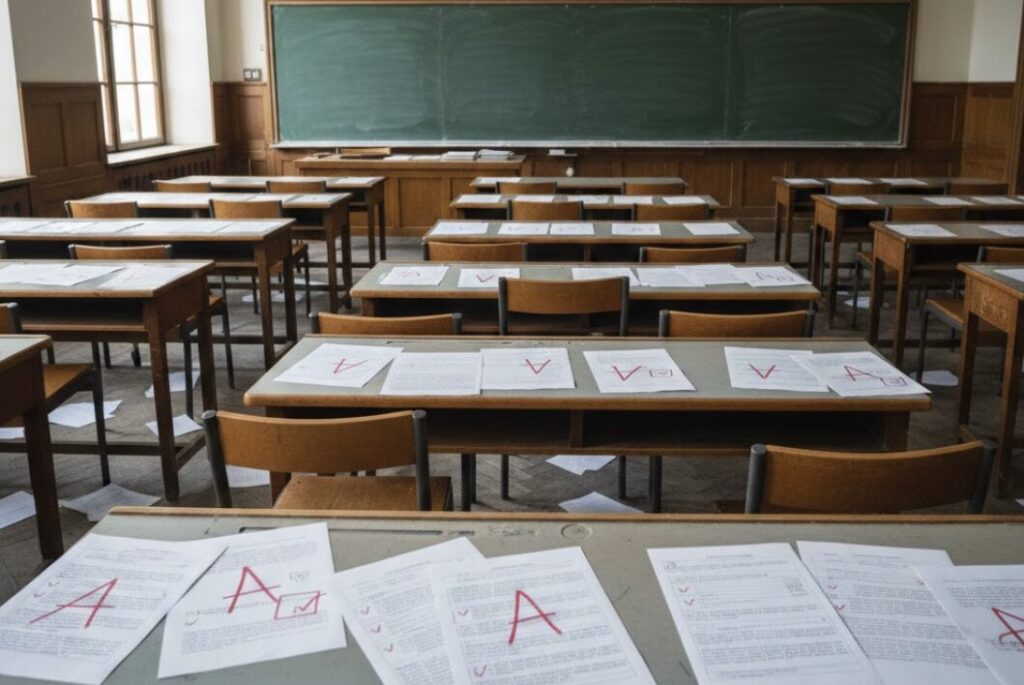
In American universities, it has been a long time since a grade of ‘A’ was an exception. Statistics showing that more than half of all grades fall within the ‘A’ range are no longer unfamiliar. On the surface, this appears to be the result of a significant improvement in student academic achievement. However, few accept this phenomenon as “progress in learning.” Rather, grade inflation is more frequently interpreted as an indicator that the overall difficulty and evaluation standards of university education have been relaxed. While grades have risen, questions about what and how much students are actually learning have become increasingly complex.
This issue was brought back to the forefront by the “Compact for Academic Excellence in Higher Education” announced by the U.S. federal government in the fall of 2025. This policy document defined grade inflation not merely as a matter of evaluation practice, but as an issue directly linked to the collapse of student learning. Subsequently, the American Enterprise Institute (AEI), a conservative think tank, redefined grade inflation as a problem inherent in the entire structure of higher education through a report expanding on the themes of the compact.
Why Grade Inflation is a ‘Learning Issue’
The core message repeatedly emphasized by the AEI report is simple: grades must reflect the knowledge and competencies acquired by a student through a course and should not rise for non-academic reasons. The problem is that reality is drifting further away from this principle. During the past few decades, while the percentage of ‘A’ grades has steadily climbed, standardized academic evaluation scores and basic academic competency indicators have often declined or stagnated. This suggests that rising grades are not the result of increased intellectual ability or cumulative learning outcomes.
The report identifies structural causes of grade inflation within universities. As factors such as course evaluations, student satisfaction, enrollment rates, and the pressure for department survival work in combination, course difficulty gradually decreases and evaluation standards become lax. This trend is particularly prominent in general education and the humanities and social sciences. In the past, reading seminars centered on classical texts and theories were common; currently, subject-oriented and contemporary culture-oriented courses make up the majority. While this is justified under the guise of “modernizing” educational content, it has simultaneously functioned to reduce the learning burden on students.
The Institutional Product of Competition
Grade inflation cannot be explained solely by the leniency of individual professors. The report points to the structural factor of competition between departments. In an environment where the number of students is directly linked to finances, departments desire to be perceived as “easy majors” rather than “difficult ones.” Departments with strict grade distributions become relatively avoided, which leads to pressure for downsizing or mergers. In this process, it is difficult for individual professors to resist grade inflation. Maintaining strict evaluations means risking lower course evaluations, student dissatisfaction, and administrative burdens. At this point, the report asserts, “The problem cannot be solved by leaving it to the autonomy of individual professors or departments.” Grade inflation is a product of the system, not a matter of individual ethics.

The Solution of ‘Disclosure’: Revealing Grade Distributions
The first solution proposed by the government compact and the AEI report is the disclosure of grade distributions. This method requires universities and departments to publicly disclose their grade distributions over several years and compare them with peer institutions. This is closer to “pressure through public disclosure” rather than direct regulation. The report explains this as a kind of “shame mechanism.” The logic is that if a university claiming academic excellence is revealed to be maintaining an excessively high ‘A’ rate, its reputation and credibility will inevitably suffer. This approach respects university autonomy to some extent by not mandating evaluation standards from a central authority, while aiming to break the practice of concealing grade inflation. However, skepticism remains regarding whether the quality of learning will automatically improve through disclosure alone.
The report also mentions university rankings as another means to curb grade inflation. For instance, if major ranking agencies like U.S. News & World Report include grade distribution as an evaluation factor, universities will be forced to reconsider artificial grade-boosting strategies. If a structure is formed where higher grade inflation becomes a point deduction factor, university options become limited. Another path is state-level intervention. Some states are setting the direction of curricula by legislating minimum standards for general education and recognizing only specific types of courses. While this triggers controversy over political interference in educational content, the report evaluates it as an inevitable choice to restore the “public nature of learning.”
A Global Challenge for the Future of Higher Education
The problem of grade inflation is not unique to the United States. South Korean universities are experiencing similar issues amidst the expansion of absolute evaluation, a culture centered on course evaluations, and the reorganization of curricula toward employment. The perception among students that “grades have risen, but the learning burden has decreased” is already widely shared. Nevertheless, public discussion regarding grade distribution and evaluation standards remains limited. While the U.S. case cannot be applied directly to Korea, it is clear that the approach of treating grade inflation merely as a matter of “student protection” or “satisfaction management” has reached its limit. The moment grades fail to represent learning, the foundation of trust in university education is bound to shake.
The core of this debate is not about lowering grades. It is about redefining what is taught, how it is evaluated, and what the results mean. Grade inflation is merely a symptom revealed in that process. Unless universities put the quality of learning back at the forefront, external pressures such as disclosure of grade distributions or ranking adjustments are likely to remain temporary prescriptions. The question “Too many As” ultimately leads to the fundamental inquiry: What kind of institution must a university prove itself to be? The debate surrounding the conditions for a university that can speak of learning, not just grades, has now entered an unavoidable stage.
#GradeInflation #UniversityLearning #HigherEducationIssues #UniversityEvaluation #SpotlightU





Leave a Reply