
This post is also available in:
 한국어 (Korean)
Achieving Stable Learning with Minimal Data… A New Solution for Reliable AI Alignment
No matter how much data an AI processes, the chronic challenge of it failing to accurately understand human intent has remained a significant hurdle. In particular, traditional learning methods that rely on simple preference comparisons (e.g., “A is better than B”) have shown limitations, often confusing the AI when data is scarce or judgments are ambiguous.
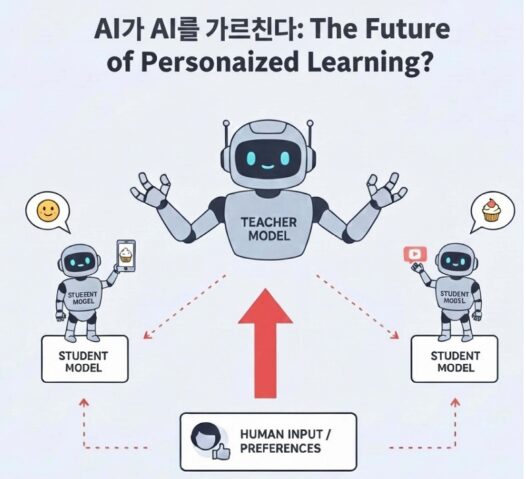
To address this, a research team led by Professor Kim Jun-mo from the School of Electrical Engineering at KAIST has developed a new reinforcement learning framework called TVKD (Teacher Value-based Knowledge Distillation). In this system, a “Teacher Model,” which deeply understands human preferences, transfers core information to a “Student Model.” The researchers liken this method to a tutor who organizes and teaches complex concepts, presenting it as a solution to simultaneously boost AI learning efficiency and stability.
The Core of TVKD: Centering the Value Function
The essence of TVKD lies in the Value Function, which numerically judges the worth of each choice, rather than relying on simple imitation or comparative learning. The Teacher Model first learns the value of various scenarios based on human preference data and then guides the Student Model by distilling this knowledge. Through this process, the AI understands “why this choice is better” within the entire context, rather than just looking at isolated comparison results. This significantly reduces the learning instability and judgment errors frequent in conventional methods.
The research team enhanced stability through two key technical mechanisms:
- Contextual Value Judgment: By reflecting judgments that consider the entire context into the student model, the AI learns a consistent decision-making structure rather than fragmented responses.
- Dynamic Weighting: The team introduced a method to adjust learning weights based on the reliability of preference data. Clear data is weighted heavily, while ambiguous or noisy data has its influence reduced. This allows the AI to converge stably even in imperfect, real-world environments filled with noise.
Global Recognition and Proven Performance
When tested on various AI models, TVKD consistently outperformed existing state-of-the-art technologies on major benchmarks such as MT-Bench and AlpacaEval. Notably, the reduction in performance variance and the significant improvement in consistency highlight its potential as an alignment technology applicable to real-world services. “In reality, human preference data is not always sufficient or perfect,” explained Professor Kim Jun-mo. “This technology allows AI to learn consistently despite these constraints, making it highly practical across various fields.”
The study, with Ph.D. student Kwon Min-chan as the lead author, has been accepted for presentation at NeurIPS 2025, one of the most prestigious conferences in the field of artificial intelligence. The research is recognized for its potential to expand into various applications, including AI safety enhancement, user-customized models, and multi-modal alignment. Supported by the Ministry of Science and ICT and the Institute of Information & Communications Technology Planning & Evaluation (IITP), this technology is expected to serve as a core foundation for developing reliable AI models in the future.
#KAIST #AIReinforcementLearning #PreferenceLearning #TVKD #ReliableAI #NeurIPS #AIAlignment



Leave a Reply