

![[Analysis] The AI-Driven Labor Market: How Will Universities Respond? – NYU and SUNY’s ‘Experiment of Validation’](https://www.spotlightuniv.com/wp-content/uploads/2026/01/20260118_05-300x161.jpg)
![[Review] Netflix’s “Can This Love Be Translated?”: The Most Beautiful Way to Correct the Heart’s Mistranslation](https://www.spotlightuniv.com/wp-content/uploads/2026/01/20260118_03-300x207.jpg)
![[Review] Materialists: A Relationship Analysis Report Disguised as a Romantic Comedy](https://www.spotlightuniv.com/wp-content/uploads/2026/01/20260115_17-300x196.jpg)
This post is also available in:
 한국어 (Korean)
Asking “What Has Died” Rather Than “Who Killed Him”
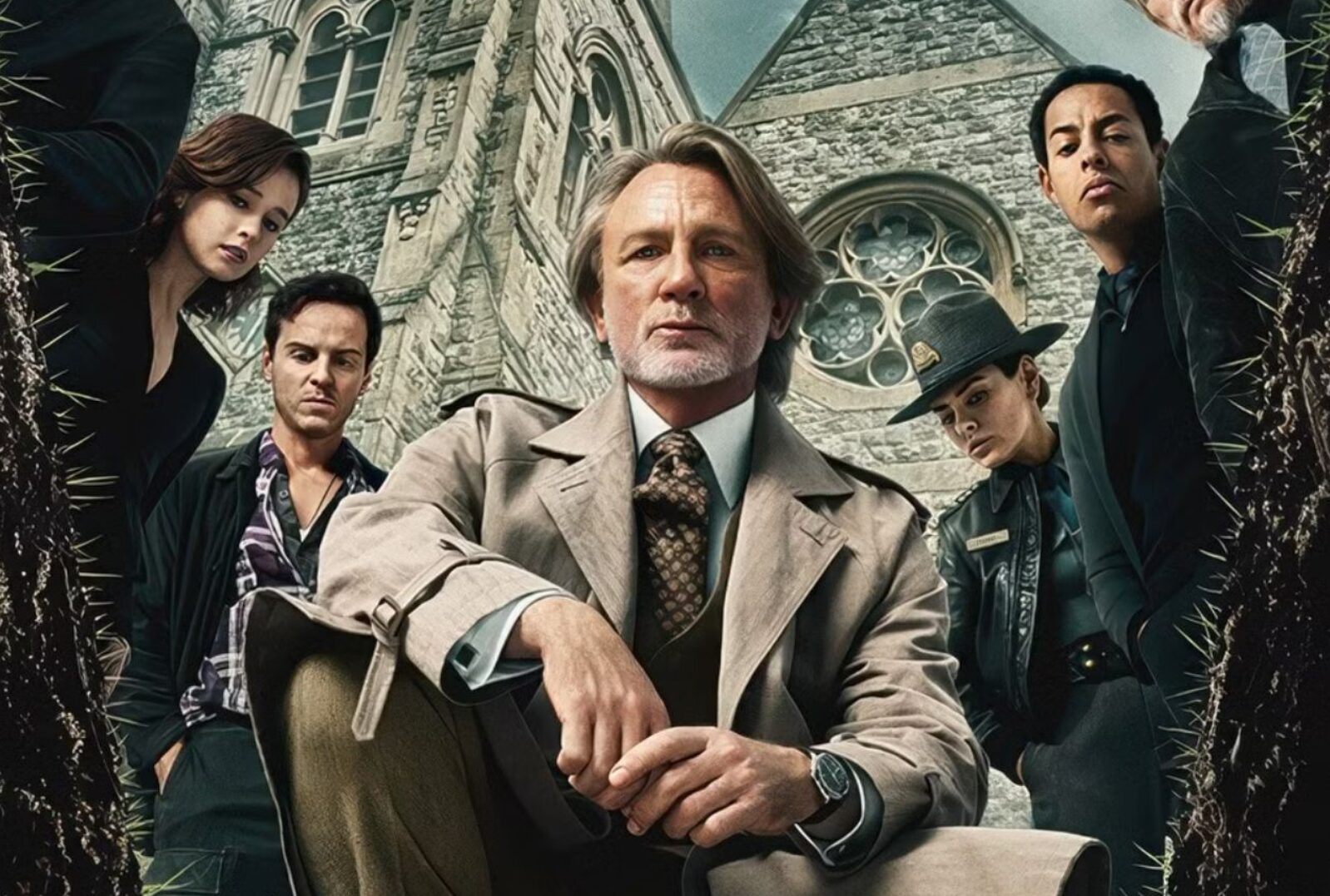
On the surface, Wake Up Dead Man: A Knives Out Mystery follows the familiar structure of a whodunnit: a closed community, a religious space, a mysterious death on Good Friday, and the arrival of a detective. However, the question this film clings to until the end is not the identity of the culprit. Instead, it asks throughout: “What was already dead?” rather than “Who killed the person?” The subject of that question is not a single individual, but an order that was operating under the guise of faith.
In this installment, Rian Johnson intentionally delays the “thrill of revealing the truth” inherent in the mystery genre. Detective Benoit Blanc does not even appear for a significant portion of the early film; instead, the audience is thrown into the atmosphere of the community. The cathedral is presented not as a place of prayer, but as a space condensed with tension, hostility, and anger. The sermons echo not as comfort, but as declarations of war. Even then, the film is saying: this incident is not an accidental crime, but the result of a long-prepared collapse.
Because of this, Wake Up Dead Man is far more uncomfortable than its predecessors. While the fun of solving the puzzle remains, what is revealed as the pieces come together is not a clear sense of justice, but a bitter ethical residue. Truth is revealed, but it does not immediately lead to salvation. This is why the film reads as both a mystery and a theological tragedy: the resolution of the crime does not equate to the restoration of order.
When a Cleric’s Sermon Becomes Hatred: Monsignor Weeks as the Already Dead
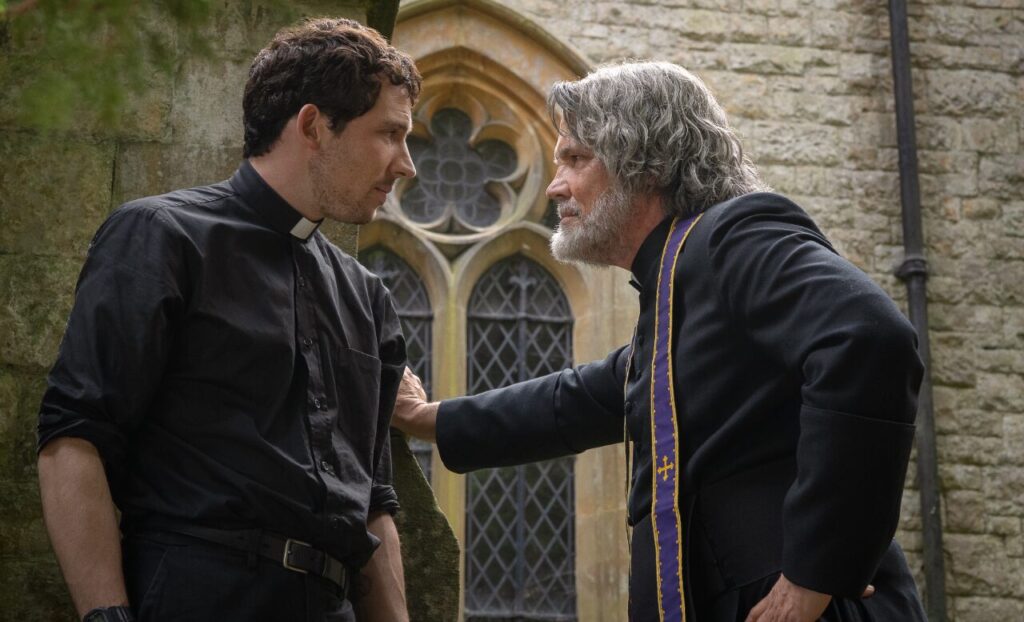
The most intense figure in the film is the victim, Monsignor Jefferson Weeks. Yet, while he is at the center of the story, he is portrayed as a figure who was already dead. Even before his physical demise, his faith had ceased to function, and his sermons had degenerated from the Gospel into the language of hostility. Weeks defines himself as a warrior at war with the world. He unites his community by constantly calling out a corrupt world, a threatening “outside,” and believers who have lost their purity.
The problem lies in his method of unification. It operates not through love or solidarity, but through fear and hatred. He preaches that one must hate the world to protect the faith, justifying that hatred as a “Holy War.” Here, the film does not mock religion; rather, it asks a more uncomfortable question: When can hatred borrow the language of faith, and how is that language circulated within a community? Weeks’ sermons are not the isolated madness of an individual; they are completed through the silence and complicity of the audience. He is not a singular villain, but a symbol of a faith that was already dead.

Cy: Not the ‘Center of Evil,’ but its ‘Distributor’
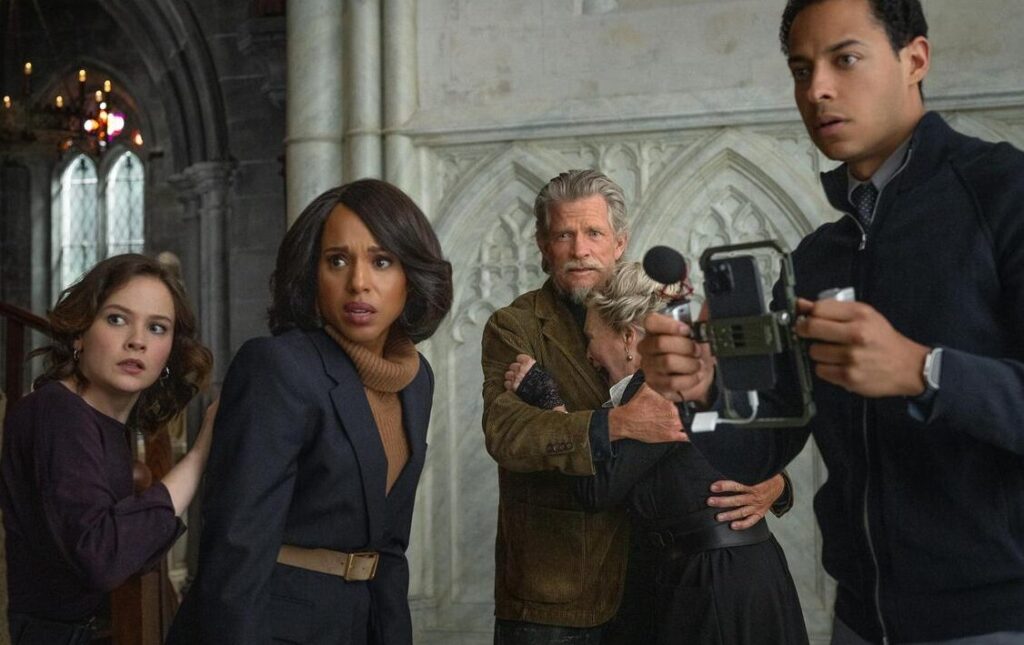
The character who moves most persistently throughout the film is Cy. He is not the one who wrote the sermons or established the theology. Yet, he remains villainous until the end because he plays the role of turning hatred and violence into the “language of practice.” Cy is not the center, but the mediator—and that is exactly why he is most dangerous.
Cy repeats and expands Weeks’ words. He translates sermons into daily life and convictions into actions. He does not see himself as evil; he believes he is on the right side. This logic—that the world is corrupt, someone must act, and the resulting violence is an unavoidable side effect—drives him. Hatred does not end with one person’s death; it is redistributed, reinterpreted, and survives under a different face. Cy remains malicious because he mistakes his actions for faith until the very end. He is not the “most evil” person, but the most “closed” one.
The Choice of Martha: What Remained Where Faith Vanished?
Martha is the most complex character in the film. She is the architect of the killing, a person who believed she was trying to protect the faith, and the one who knew best that such faith no longer existed. The problem is not what she did, but why that choice was possible.
Martha seeks to turn Weeks into a “Resurrected Priest.” Her attempt to reconstruct his death as martyrdom and turn a flawed human into a flawless symbol is a desperate desire to maintain faith through symbols and myths when it can no longer be saved in reality. To her, what matters is not truth, but continuity; not repentance, but influence. Her “resurrection” is not a restoration of life, but a manipulation of memory. Her actions were not to protect faith(faith), but to hide the void where faith had vanished.

Father Jude: What Should a Cleric Be?
If there is one pillar that does not collapse, it is Father Jude. He is not perfect; he has a history of violence and lives with that guilt. However, in that very imperfection, Jude reveals the minimum requirement of a cleric: not teaching or authority, but the attitude of being present.
Jude performs faith in the exact opposite way of Weeks. He does not declare war on the world or categorize the community. Instead, he stops to listen. During the investigation, a scene where Jude stops in his tracks for a single phone call is symbolic. Choosing immediate suffering over the “truth” of the case defines his priesthood. He does not provide a dramatic salvation, but he does not spread destructive violence either. He creates a space where confession(confession) becomes possible.
Benoit Blanc’s Shift: From Solving Detective to Listening Witness
In this film, Benoit Blanc stands in a different position. While he still grasps all the facts, he does not always reveal them immediately. His role is not a “solver” pointing out the culprit, but a “witness” waiting for the truth to reveal itself.
This shift is an ethical choice. As a detective of reason, he recognizes the limits of reason. He knows that speaking the truth does not always implement justice and that exposure can trigger further violence. Therefore, he does not use the truth as a weapon. Instead, he leaves room for confession. In the climax, silence and suspension intervene instead of the detective explaining everything. Blanc “resolves” the case, but he does not “purify” the world.

Conclusion: Truth Revealed, Justice Deferred
The ending of Wake Up Dead Man intentionally leaves a feeling of incompleteness. The structure of the crime is exposed, but the community neither completely collapses nor is completely renewed. The cathedral reopens, and people return to their daily lives.
This ending is a declaration: justice is not completed by a single exposure, and faith is not restored all at once. The ethics shown in this film are cold. All sins start from desire and lies, and they become most dangerous when they wear the language of faith. Yet, the film suggests that faith has not completely disappeared; it can start again in the tiny space where confession becomes possible.
Wake Up Dead Man is not a film that attacks religion. Rather, it shows how easily religion can betray itself. When the sanctuary is filled with hatred, faith becomes a tool for division rather than a force for life. The film asks: Was it faith that tried to wake the dead, or was it desire utilizing faith? The most uncomfortable truth is this: What needs to wake up is not the dead, but our own convictions that have already hardened while we are still alive.
#WakeUpDeadMan #KnivesOut3 #KnivesOut #WakeUpDeadManReview #MysteryMovie #ReligiousFilm #TheologicalTragedy #SanctuaryOfHatred #FaithAndDesire #ConfessionAndRedemption #ClericalEthics #RianJohnson #BenoitBlanc #NetflixMovie #FilmCritique #FilmAnalysis #SpotlightU
![[Review] Netflix’s “Can This Love Be Translated?”: The Most Beautiful Way to Correct the Heart’s Mistranslation](https://www.spotlightuniv.com/wp-content/uploads/2026/01/20260118_03-768x530.jpg)
![[Review] Materialists: A Relationship Analysis Report Disguised as a Romantic Comedy](https://www.spotlightuniv.com/wp-content/uploads/2026/01/20260115_17-768x502.jpg)