


![[Analysis] The AI-Driven Labor Market: How Will Universities Respond? – NYU and SUNY’s ‘Experiment of Validation’](https://www.spotlightuniv.com/wp-content/uploads/2026/01/20260118_05-300x161.jpg)
![[Review] Netflix’s “Can This Love Be Translated?”: The Most Beautiful Way to Correct the Heart’s Mistranslation](https://www.spotlightuniv.com/wp-content/uploads/2026/01/20260118_03-300x207.jpg)
![[Review] Materialists: A Relationship Analysis Report Disguised as a Romantic Comedy](https://www.spotlightuniv.com/wp-content/uploads/2026/01/20260115_17-300x196.jpg)

This post is also available in:
 한국어 (Korean)
The Return of a ‘Dialogue-Centric Psychological Drama’ Rarely Seen in Korean Cinema
The Neighbors Upstairs garnered public interest even before its release, marketed as an adult comedy. However, the film’s identity lies much deeper than its superficial genre of adult comedy. The story begins with the familiar topic of noise between floors, but what the audience encounters is not a simple farce but the essence of a relational psychological drama, formed by the entanglement of four people’s words, expressions, and unspoken emotions.
In particular, director Ha Jung-woo’s chosen directorial style is highly theatrical and classical. Minimizing space, reducing events, and making dialogue itself the driving force of the narrative is an attempt rarely seen in contemporary Korean commercial cinema. The film does not hide the moments that make the audience feel uncomfortable; rather, it aims to expose the layers of emotion through that discomfort. Thus, The Neighbors Upstairs is funny yet unlaughable, uncomfortable yet unignorable, and a subtle warmth permeates the moments when the wounds hidden behind the humor are revealed. This emotional complexity is the film’s strength.
What makes The Neighbors Upstairs intriguing is the emotional cracks and recovery created by the four actors projecting their psychologies and desires onto each other on what is essentially a single stage. The film obsessively delves into the fact that relationship cracks begin in everyday trivialities, and the silence that passes as if nothing happened ultimately desiccates the relationship itself. It is at this point that the film connects with the reality of Korean society. The audience naturally experiences through the four people’s conversations how unspoken words in family and marital relationships become misunderstanding, ignorance, and indifference. The audience’s discomfort is not a sign that the film is excessive, but because all of us were, in fact, aware of this discomfort. The film compels us to confront, not push away, that discomfort. In this sense, The Neighbors Upstairs is a psychological drama disguised as an adult comedy, containing a modern message about relationship recovery.
Korean Variation of the Spanish Original Sentimental
The Neighbors Upstairs is based on the Spanish film Sentimental (2020). Although the structure is similar, the Korean version reconfigures the intensity of expression and the emotional tone to better fit the Korean context. If the original was characterized by European humor and the directness of exposed emotions, these elements were more audaciously transformed in the Korean version.
Director Ha Jung-woo, in particular, maintained the dialogue-based structure of the original while meticulously weaving in the characteristic emotional suppression, silent communication, and differences in role expectations of Korean couples, constructing an emotional thread that resonates more directly with the Korean audience. The enhanced contrast of characters and points of emotional explosion in the Korean version do not distort the original’s theme but show more deeply the weight that ‘unspoken words’ carry in a relationship. This Korean variation is not a simple remake but expands into an independent interpretation that reflects the structure of intimacy in Korean society.

Director Ha Jung-woo’s choice of an indoor play setting is a critical decision that determines the film’s character. Most scenes take place inside an apartment, and the constraints of the space become a device that intensifies the emotional spread. Without exaggeration, the changes in the four people’s voices, gazes, and expressions are captured in a cramped space, making the audience face the emotions at almost the same distance as the actors. This creates the illusion that the audience is sitting as the fifth person in the room, listening to their conversation. The sense of stifling and discomfort the audience feels is an intentional design, and the resulting sense of liberation when the characters’ emotions explode is thus delivered more strongly. This indoor-play approach is uncommon in Korean commercial cinema but was ultimately the most effective choice for conveying the film’s theme.
The Downstairs Couple: The Time of Relationship Hardened by Unspoken Words
The downstairs couple (Gong Hyo-jin and Kim Dong-wook) appear to be a relatively ordinary and stable couple in the film’s beginning. They are characters who, despite raising the issue of noise between floors, choose to internally endure it and push their emotions behind mundane conversations rather than resolving it directly. This period of silence appears stable on the surface but, in reality, exposes the dried-up surface of a relationship where expectations and desires for each other were left unsaid. The wife had long desired something but did not express it, and the husband failed to sufficiently look into what his wife was waiting for.
What sustained this couple’s relationship was closer to a ‘habit of avoiding conflict’ than a sustained affection, and this habit ultimately led to mutual misunderstanding. The reason they didn’t fight from the start was not maturity but the result of spending years without conveying their emotions and desires for each other verbally. The film subtly captures the accumulation of their silence, naturally showing that the cracks in seemingly solid relationships begin quietly from within. The moment the downstairs couple realizes their relationship has begun to tilt is the very starting point of their discomfort in conversation with the upstairs couple.
The characteristic of this couple is a state of not being able to accurately read each other because the time of unspoken words has become too long. The wife’s words are deliberate yet dry, and the husband believes adequate consideration and the repetition of routine are the way to maintain the relationship. However, in reality, that consideration had gradually transformed into a way of consuming the relationship rather than protecting each other. Neither asked what the wife wanted nor what anxiety the husband felt, and as they didn’t ask, the misunderstanding hardened further. Through the scenes where their conversations intentionally diverge, the audience confirms the emotional reality that ‘unspoken words lead to ignorance, and ignorance breeds indifference.’ This couple’s conflict does not start from a major event. Rather, it is a crack formed by accumulated emotions that unknowingly drifted apart within the time not questioned, the needs not cared for, and the patterns of life taken for granted. This crack begins to reveal itself only with the appearance of the upstairs couple. The film accurately captures the small truth of real-world relationships in that even this couple did not deeply recognize the rift before then.
The Upstairs Couple: Psychological Shock Delivered by Nakedness and Freedom
In contrast, the upstairs couple (Ha Jung-woo and Lee Ha-nee) are characters who embody the emotional freedom and honesty that the downstairs couple had been avoiding, to an extreme degree. They do not hide their desires, do not suppress their emotions, and engage in conversations that sometimes appear inappropriately direct. Their naked lifestyle and relational style become a kind of psychological shock to the downstairs couple. To the seemingly ordinary couple, this pair is strange and uncomfortable, and that discomfort functions not as an object of avoidance but as a mirror reflecting the deficiency in their own relationship. The freedom of the upstairs couple is not a simple dramatic device but a catalyst that forces the desires and anxieties hidden by the downstairs couple to be revealed. Their audacity becomes an opportunity to expose the reality of the downstairs couple’s deficiency, and a device that makes the audience sensually feel the temperature difference between the two couples’ relationships.
The appearance of the upstairs couple is structurally the starting point that shakes the silence of the downstairs couple. They are sometimes perceived as hurting the other because they do not hide their desires, but at the same time, they clearly reveal what the other person truly wants. This attitude resonates with the downstairs couple. To those who believed that unspoken words were politeness and consideration, this becomes an opportunity to realize that honesty is not carelessness but the minimal foundation for maintaining a relationship. This naked couple is the central axis that provides discomfort throughout the film, but as the story progresses to the latter half, that discomfort transforms into a function of therapeutic shock. They stimulate the hidden wounds of the downstairs couple, showing that the relationship only begins to breathe again when those wounds are revealed. The conversations between the four people often seem excessive and aggressive, yet within that aggressiveness, the downstairs couple learns the necessity of honesty.
Plot Driven by Dialogue: A Structure Where Words Themselves Become Events
The biggest characteristic of The Neighbors Upstairs is that dialogue goes beyond merely explaining situations or conveying emotions; it immediately becomes the event itself. The narrative unfolds around the density and speed of the dialogue clashes between the four characters, and the emotional fluctuations those conversations create. Therefore, what is important in this work is not what event occurs, but what words were exchanged and how those words changed the relationship between the characters. The plot of this film naturally forms according to the progression of the dialogue, and the narrative progresses in a way that the choice of words and the avoidance of words generate cracks between the characters. In fact, the audience feels tension throughout, even with almost no scene changes or external events. This is because the dialogue functions as a device that directly reveals the characters’ inner selves, not just simple information transfer.
The theatrical composition consisting only of dialogue heightens the narrative density of this work, providing the audience with a time for ’emotional reading’ to decipher the relationship between the four people. In this emotional reading process, the audience naturally becomes immersed in the flow of the characters’ emotions, understanding the structure where the four people’s voices and expressions instantly become cinematic events.
Dialogue-centric films are often evaluated as dry, but The Neighbors Upstairs uses this very dryness as a tool to form emotional depth. Dialogue reveals the characters’ wounds and desires even in moments that flow like a joke, and sometimes even explicit expressions, embarrassing for the audience to hear, are used as a device to amplify the emotional range. The dialogue in this film is particularly interesting because it sounds like humor, yet that humor does not conceal the emotions but rather vividly reveals the essence of the emotions. The audience laughs but suddenly feels discomfort at a certain dialogue, witnessing the moment of emotional rupture after that discomfort accumulates. This emotional curve is not simply created by comedic rhythm but is a refined structure formed by the intricate accumulation of the rhythm of dialogue, the intensity of expression, and the way they react to each other’s words. Thus, The Neighbors Upstairs succeeds in maximizing the power of words by extending dialogue as a narrative motif in a way rarely seen in Korean cinema.
The Aesthetics of Discomfort: The Emotional Texture Revealed When the Audience is Shaken
The greatest emotion the audience feels in this film is clearly ‘discomfort.’ That discomfort stems not merely from the level of exposed dialogue or sexual expressions, but from the emotional stimulation that reminds the audience of conflicts and evasions within their own intimate relationships. The naked remarks thrown by the upstairs couple are not only a shock to the downstairs couple but also approach the audience like an uncomfortable mirror. The audience instinctively senses that these dialogues are not just the story of the four people but scenes that could fully occur in their own lives and relationships, and that instinct leads to a complex emotion where discomfort and empathy coexist.
This discomfort is not cinematic unconventionality but a composition designed to emphasize psychological realism. Through the discomfort, the audience reads the layers of unspoken emotions beyond the surface of the dialogue, and understands the complex psychologies interwoven in the four people’s conversation.
Discomfort also functions as a device to reveal the essence of the relationship. The moment unspoken desires, hidden shame, and emotions one did not want the partner to discover inadvertently leak out through dialogue, the audience realizes how these fragments of emotion have created cracks in the relationship. Especially for the downstairs couple, because the unexpressed emotions had been condensed for a long time, the process by which the upstairs couple’s freedom evokes an explosive sense of liberation is naturally understood. This film does not demand that the audience ‘endure the discomfort.’ Rather, it is a work that shows through every sentence and every expression that ‘you can only reach the truth of the relationship by passing through the discomfort.’ Within this structure, discomfort becomes an aesthetic that reveals the emotional texture, completing the emotional depth of the message the film intends to convey.
The Moment the Fight Becomes the ‘Beginning,’ Not the Climax
Reaching the middle of The Neighbors Upstairs, emotional cracks begin to fully emerge in the downstairs couple. Until then, the couple had maintained quiet conflict and packaged themselves as a stable relationship, but through conversation with the upstairs couple, they finally confront how dangerously their accumulated emotions were stored. Notably, the fight that breaks out between the two is directed differently from typical marital conflicts. However, this fight is ultimately not a process of relationship collapse but rather a process of the relationship coming back to life. The moment the emotions suppressed by unspoken words explode, the misunderstandings, grievances, and inexplicable desires that were deeply rooted in their hearts surface. This explosion is like the labor pains for a restart, not destruction. As the audience listens to the emotional language the two pour out toward each other, they instinctively sense that this fight is not ‘a fight heading toward an end’ but ‘a fight to reach each other for the first time.’ In this film, the fight is not an emotional catastrophe but the starting point of the relationship, and this paradoxical structure becomes a critical turning point that determines the emotional depth of the film.
The reason the audience perceives this fight as a signal of recovery is that this explosion is the very moment the two begin to accurately convey their inner feelings to each other. The wife had not expressed what she wanted, and the husband misunderstood that silence as consideration. But the moment the emotional rupture occurs, the two understand for the first time what the other has been thinking and what they have been enduring. The argument is not an emotional drain but a process of rebuilding the foundation of mutual understanding. Realizing that the time they spent in silence to avoid hurting each other had actually weakened the relationship, the two re-examine the roots of their relationship through the emotion of fighting. The film captures this process realistically and subtly, quietly conveying the fact that fighting can sometimes be the necessary form of honesty for recovery. This emotional truth also deeply resonates with the audience. Because everyone has experienced a relationship drifting apart due to unspoken words, the audience feels a strange sense of liberation amidst the discomfort in this scene.
The Moment They ‘See’ Each Other for the First Time After the Emotional Explosion
The emotion that follows the emotional explosion is not emptiness or anger but a kind of ‘silent clarity.’ This silence allows a new starting point for the two people whose vision had been obscured by tangled emotions. They quietly look at the hidden pieces of the other’s heart, beginning to understand why those pieces were so distorted. The film conveys the essence of the relationship recovery process through this quiet scene immediately after the fight. Recovery does not begin with words of reconciliation or emotional embraces, but with ‘seeing’ the other person again. This moment of seeing is an emotional turning point that makes them realize that the person they thought they knew was, in fact, very different, very tired, and had been waiting for a lot. This realization creates a moment of emotional reconnection that transcends mere understanding.
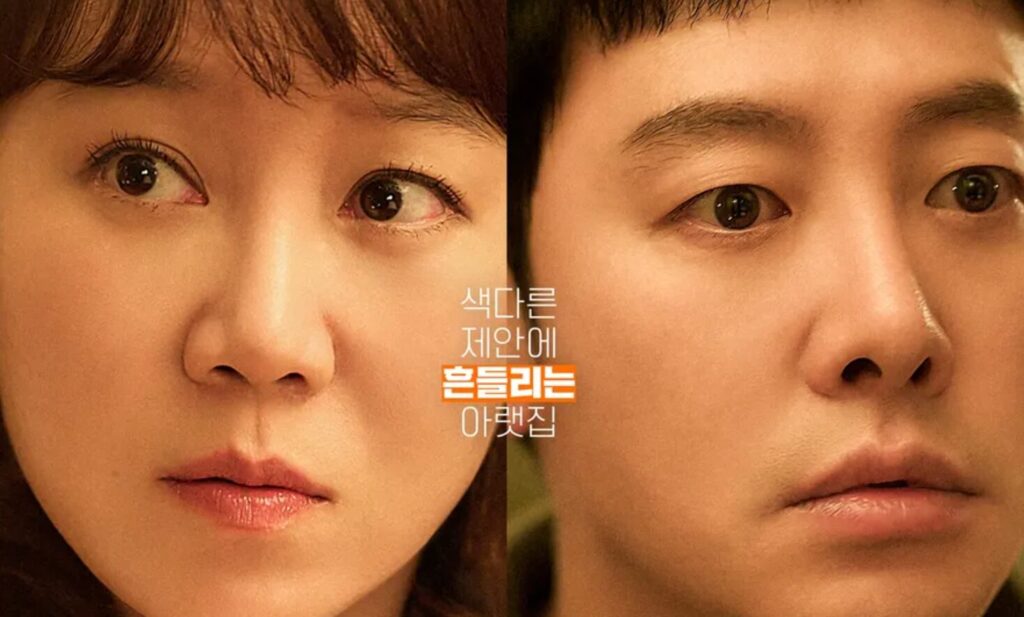
In this moment, the downstairs couple in the film appear to each other as honest beings for the first time. The two, who had previously hidden their emotional surface and focused only on relationship maintenance, reconnect with the other by revealing their own wounds and deficiencies after the explosion. Psychologically speaking, this scene is close to the process of ‘re-attunement’ between the couple. It is ironic that re-attunement only became possible after long-repressed emotions exploded, but that very irony is the genuine reality the film presents. The two quietly begin the process of rediscovering each other, seeing each other again, and bringing the relationship back to its center. Through this scene, the audience understands that recovery is not a spectacular solution but the smallest emotional movement of acknowledging each other. This is also the essence of the relationship the film seeks to convey.
The Hug Scene: Emotional Reconnection Reaching Before Words
In the film’s latter half, the scene where the two people hug after the emotional explosion and the ensuing quiet is the core moment that converges the entire film’s emotion. This hug is not a simple reconciliation but a signal that they have reached each other again. Through the fight, they finally understood what the other had been enduring, what they couldn’t say, and why they had drifted apart, and this process of understanding is condensed into the simple action of a hug. A hug is a way of conveying emotion faster than language. The emotional clarity that is difficult to explain in words—the message that “we can now start again”—is contained within this short scene. The two do not say anything to each other, but the audience instinctively understands that the dryness that had accumulated for so long is slowly melting away. This scene transcends the dichotomy of fighting and reconciliation, conveying the fact that the real moment of relationship recovery is ’emotional reconnection,’ not words.
This hug contains gratitude, encouragement, and a belated acknowledgment of each other. It is also a scene that makes them reflect on the time they failed to look out for each other due to being busy, being familiar, or not wanting to be hurt. The hug contained the recognition, gratitude, and respect for each other’s existence, having passed through a tunnel of life together. Therefore, this hug acts as a signal of connection that emotionally embraces the entire film’s discomfort, implying a new direction for the relationship guided after the emotional explosion.

Why Is This Film Meaningful Within the Korean Relationship Discourse?
The Neighbors Upstairs, while superficially adopting the form of an adult comedy, is a work that delicately reflects the relational structure of Korean society. In particular, the film handles the accumulated time of silence and misunderstanding between couples very realistically, clearly showing that the process of a relationship collapsing stems not from major events but from small deficiencies and subtle emotional disregard. In the Korean context, it is true that couple and family relationships have prioritized implicit understanding and cautious emotional restraint over overt conversation, and this cultural background sometimes solidifies emotional distance. The film precisely captures this point. The reason the naked actions and words of the upstairs couple feel strange and uncomfortable is not that they are excessive, but because we have not experienced that level of honesty in our relationships. Through uncomfortable scenes, the film pulls out the time we have avoided emotional truth, emphasizing that this time creates cracks in the relationship. Therefore, this film is not simply a work about four people’s dinner but is read as a social text dissecting the structure of Korean intimacy and silence.
Furthermore, the film offers a fresh perspective on how relationships recover. While many films rely on major events or dramatic turning points for conflict resolution, The Neighbors Upstairs explains relationship recovery through the realistic frame of ‘the recovery of small conversation.’ The film takes a different trajectory from existing relationship narratives by emphasizing that the moment fighting occurs and emotions explode is not a tragedy but a process of accessing the truth. In Korean society, conflict tends to be treated as a negative event that should be avoided as much as possible, but this film quietly shows that the relationship can only revive if conflict is confronted, not evaded. The cat, symbolizing the wife’s desire, functioning as a signal that the emotional structure has been rebuilt rather than just a practical change, is in the same context. Ultimately, this film provides an answer to how a couple’s relationship can revive, not how it perishes, and that answer contains a message applicable to real-world marital or romantic relationships. In this regard, The Neighbors Upstairs is evaluated as a meaningful work that embraces both laughter and discomfort to re-examine the essence of relationships.
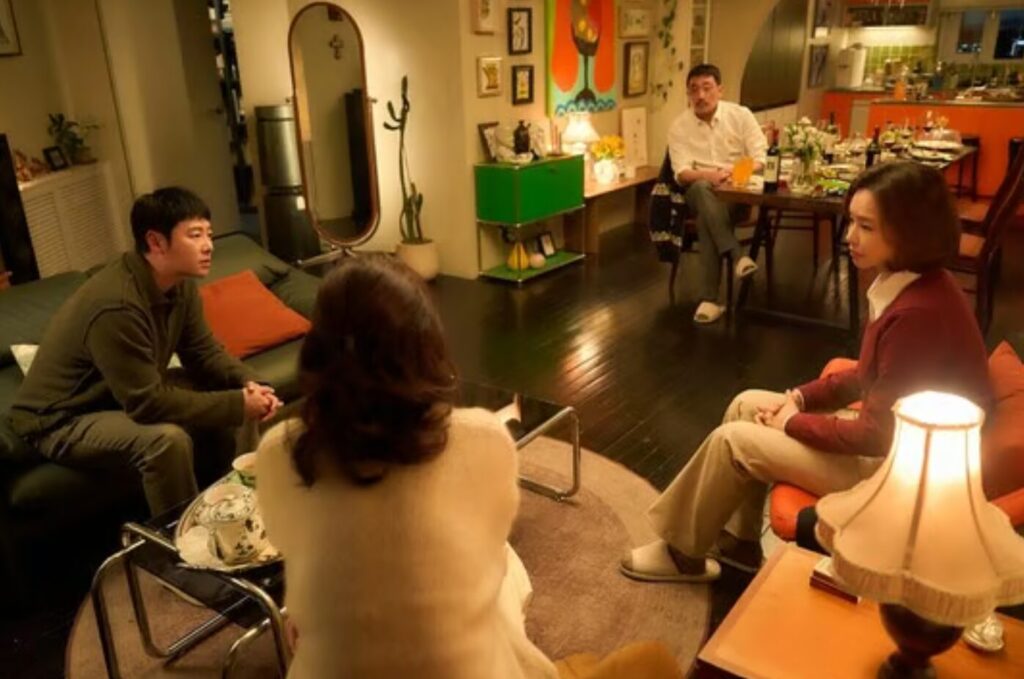
The Neighbors Upstairs questions the essence of relationships through the uncomfortable conversations of four people. It quietly shows that fighting is not the end of a relationship but the beginning of truth, and that one can only reach the possibility of a relationship by passing through the discomfort of dialogue. The film borrows the form of an adult comedy, but the message contained within is much more serious and realistic. It meticulously explores how unspoken words desiccate a relationship, how small desires turn into deficiencies in long silence, and how those deficiencies can be refilled. The final scene of the cat walk is the emotional completion of this entire process. The sight of the two people acknowledging each other’s desires again, walking in the same direction past the time they didn’t speak, is not a simple reconciliation but the moment the relationship is rebuilt. Ultimately, this film quietly reminds us of the simple but forgotten truth that maintaining a relationship is placed on such delicate emotional adjustments, and when those adjustments fail, what is needed is the recovery of dialogue.
The Neighbors Upstairs is a rare dialogue-centric work in Korean cinema, yet it leaves a unique resonance precisely for that reason. Immersing the audience by oscillating between discomfort and laughter, this film delicately handles suppression, silence, and recovery in intimate relationships, ultimately prompting reflection on what force sustains a relationship. The film suggests that the process of a relationship moving away or drawing closer begins at the intersection of words and hearts. And as long as there is an attempt to reconnect those words and hearts, the relationship can always begin anew. The Neighbors Upstairs is a film that is funny yet painful, uncomfortable yet warm, quietly illuminating the truth of relationships.
Past the Depth of Unspoken Time to Walk in the Same Direction Again
#TheNeighborsUpstairs #HaJungwooDirector #GongHyoJin #LeeHaNee #KimDongWook #SpanishOriginal #Sentimental #RelationshipPsychologicalDrama #CoupleMovie #DialogueCentricFilm #KoreanMovieRecommendation #AdultComedy #NoiseBetweenFloorsMovie #MovieInterpretation #MovieReview #RelationshipRecovery #EmotionalPsychology #CatSymbolism #PsychologicalDrama
![[Review] Netflix’s “Can This Love Be Translated?”: The Most Beautiful Way to Correct the Heart’s Mistranslation](https://www.spotlightuniv.com/wp-content/uploads/2026/01/20260118_03-768x530.jpg)
![[Review] Materialists: A Relationship Analysis Report Disguised as a Romantic Comedy](https://www.spotlightuniv.com/wp-content/uploads/2026/01/20260115_17-768x502.jpg)


