
This post is also available in:
 한국어 (Korean)
How the “King of Evidence”—the Confession—Destroys the Truth. The Pinnacle of Korean Psychological Thrillers Born from the Collision of Two Women’s Lives.
The Netflix thriller 「The Price of Confession」 establishes a peculiar sense of unease from its very first scene. Rather than the fact of the crime itself, what immediately catches the eye is the way the explanations and interpretations surrounding the crime clash. From the moment ordinary art teacher Ahn Yoon-su finds her husband murdered, she is gradually transformed from a “victim” into a “suspect candidate” under the gaze of investigative agencies, the media, and public opinion.
The work deliberately avoids exaggerating this rapid transition. Instead, it meticulously demonstrates how subtle tremors in everyday speech, behavior, and facial expressions are assembled into clues for suspicion. The fact that Yoon-su drank coffee after reporting her husband’s death, her calm demeanor during questioning, and her brief smile during a moment of relief are all categorized as “abnormal” behaviors. These fragments of information function not as objective evidence, but as devices to reinforce the narrative people want to see. Through this, the series peers into how easily the concept of “truth” becomes subordinate to preference and emotion. It slowly reveals that truth is not an accumulation of objective facts, but a combination of ideas someone has chosen to believe.
This early stage hints at the direction of the work. While 「The Price of Confession」 aims to solve a murder case, its methodology sits at the polar opposite of traditional courtroom drama formulas. In other words, truth stands in the back while misunderstanding takes the lead. The collapse of Yoon-su’s life is closer to the violence created by “how people interpret her” rather than the shock of the incident itself. The audience naturally becomes aware of the investigative agencies’ prejudices, yet simultaneously understands why Yoon-su’s reactions invited suspicion. This paradoxical empathy serves as the engine for the tension from early on.

Ahn Yoon-su and Mo-eun: Moments Where the Boundaries Between Victim and Perpetrator Blur
At the rock bottom of Yoon-su’s life, Mo-eun appears. Known as “The Witch” in prison, Mo-eun is an object of fear and distrust. However, the work does not depict her as a mere monster. Instead, it suggests a deep fracture within her as she attempts to control situations with a cold face and refined, quiet language. She is a murderer feared even by her public defender, yet a contradictory being who seeks help from and offers help to another.
The relationship between Yoon-su and Mo-eun begins as a “deal.” Mo-eun’s proposal—to confess that she killed Yoon-su’s husband—is unrealistic, but for a desperate Yoon-su, it is the only remaining hope. A confession could bring her freedom, but it is a double-edged sword that could also burden her with another form of guilt. From this moment, the relationship between the two women loses its balance around the question: “Who is using whom?”

As time passes, this utilitarian relationship evolves beyond a mere transaction. Mo-eun understands Yoon-su’s shattered psyche, and Yoon-su senses Mo-eun’s deep wounds. As they peer into each other’s lives piece by piece, the distance between them becomes more ambiguous. They become threats to each other, yet simultaneously each other’s only support. This subtle emotion prevents viewers from clearly defining either as a victim or a perpetrator. 「The Price of Confession」 draws its ethical tension and emotional absorption precisely from this fluid boundary.
An Exchanged Confession: Redefining Truth
While a confession is usually considered the most critical moment in a crime drama, in this work, it holds a unique meaning not as a “false confession,” but as an “exchanged confession.” Mo-eun’s confession seems like the key to rescuing Yoon-su from prison, but it is actually the starting point that lures Yoon-su into another trap. The confession does not reveal the reality of the incident; instead, it acts as a tool to shift the landscape of relationships, power, and desire.

The meaning of the confession becomes more complex toward the middle. What power can the words of another have when they take on one’s own guilt? Legally, it carries weight; ethically, it creates a rift. Yoon-su, relying on Mo-eun’s confession, becomes free, but that freedom can easily turn into a threat that could strangle her at any moment. Confession is no longer a “confession of truth,” but a technique for shaking the truth to create a new reality.
This structure keeps the viewer in a state of constant anxiety. The truth is not found within the confession itself, but hidden within the purpose and price of the confession, and the intentions of those listening to it. Therefore, 「The Price of Confession」 does not follow the rules of traditional investigative procedurals. Here, truth is revealed only by following the question: “Who is speaking, and for what purpose?” This unique progression builds an overwhelming tension that explodes in the final episodes.
Direction that Heightens Both Genre Tension and Psychological Pressure
While 「The Price of Confession」 appears to be a typical crime/courtroom thriller on the surface, it is a work that builds tension by intricately constructing character psychology and relationships. The direction focuses more on internal pressure than narrative shock. For example, even when characters’ emotions reach their limit, the music does not intrude; instead, the silence or the emptiness of the space is emphasized. This direction creates a much larger emotional ripple.
Furthermore, while the 12-episode runtime might seem long based solely on the plot, it serves as the necessary time to elaborately build the characters’ emotional changes. It allows enough room to observe what each character chooses and gives up, which becomes a device that enhances emotional persuasiveness at the end. Viewers must follow the emotional rifts and internal changes of the two women with a long breath to see the full picture.
Prejudice and Normality: The Shadow Cast on Yoon-su
The series sharply exposes social prejudices through the lens of an investigation. The scenes where Yoon-su is suspected simply because she does not look like a “normal victim” are beyond uncomfortable—they are realistic. In Korean society, a victim is often accepted as “believable” only when showing specific emotions and attitudes. If grief is excessive, it’s called acting; if it’s lacking, it’s called apathy. Yoon-su loses the truth because she is trapped by these “standards of normality.”

The confirmation bias of Prosecutor Baek Dong-hoon extends from an individual issue to a systemic one. From the moment he believes Yoon-su is the culprit, he processes every clue to fit that belief. He is not searching for the truth; he is obsessed with proving the truth he has already decided upon. This process shows the moment the judicial system deteriorates from “solving” a case to “managing” it. The damage of this prejudice is always concentrated on the weakest individual.
Mo-eun’s Tragedy: Cruel Choices When Systems Fail
Mo-eun’s narrative is the darkest layer of the work. Her family’s tragedy is not just an incident; it is a chain reaction of destruction that occurs when institutions and society fail to act as a safety net. Despite her sister being a victim of sexual violence, she was not properly protected, and because of the juvenile offender system and cover-ups by the powerful, the perpetrator walked away laughing. Mo-eun’s rage begins there.
It becomes understandable why she calls herself a “witch” and walks into the darkness. Here, the work once again sheds its genre shell. Instead of the typical catharsis of a revenge drama, it directly portrays the guilt and helplessness that follow revenge from start to finish. Mo-eun’s choice is not about justice; it is a desperate struggle to hold onto the ruins of a collapsed life. As that desperation collides with Yoon-su’s life, their relationship reaches a new dimension. Instead of asking “Who is right?”, the question “Who had to live like this?” arises.
The Reality of Sin Concealed by the Jin Young-in Couple
The narrative gains social explosive power at the moment the real culprit of the Lee Gi-dae murder case is revealed. The truth, which even Prosecutor Baek Dong-hoon—who suspected Yoon-su from the start—could not anticipate, is this: the person who killed the husband, Lee Gi-dae, was not Yoon-su, but lawyer Jin Young-in and his wife, Choi Su-yeon.
This truth is shocking yet simultaneously too familiar. The way those with social power solve problems is not by facing facts, but by “managing” them. They did not try to resolve the discomfort that began with a minor argument with an apology; instead, a single honest word Lee Gi-dae said while evaluating a painting touched their pride. Their way of healing that wound was not through dialogue or reconciliation, but through the exercise of violence and the technique of concealment. Choi Su-yeon killed Lee Gi-dae in a fit of heightened emotion, and Jin Young-in meticulously manipulated the appearance and timing of the incident as if preparing a defense.
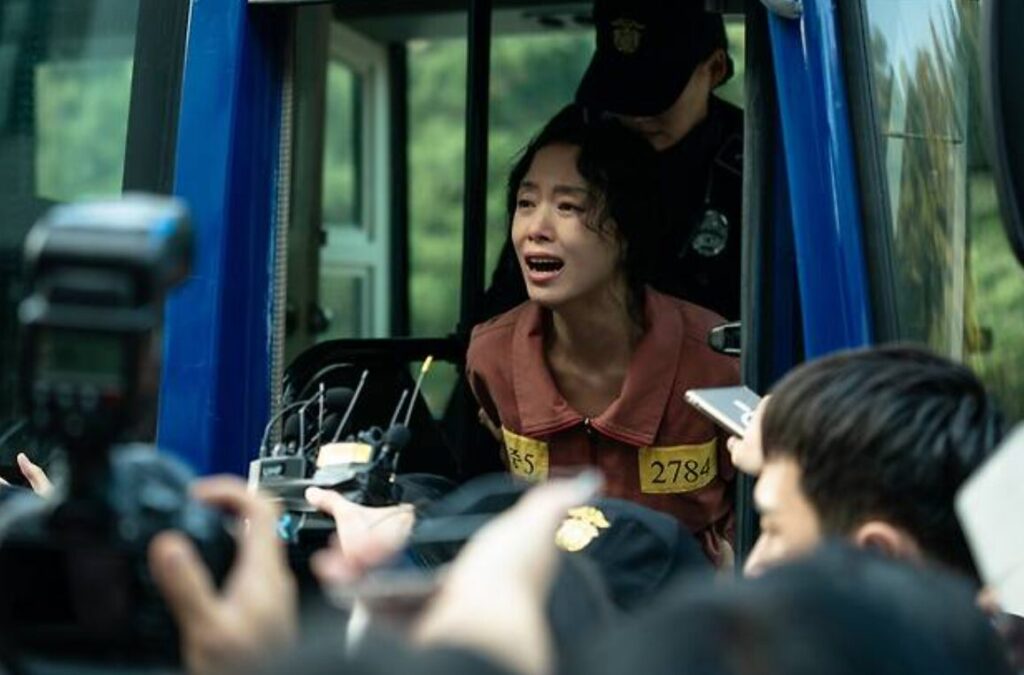
Acting that Fills the Screen with Emotional Texture
Jeon Do-yeon’s acting serves as the solid anchor of this work. She does not express Yoon-su’s collapse in an exaggerated or dramatic way. Instead, she expresses emotion through the shaking of small, everyday textures—the decrease in speech, the emptying of expressions, and the momentary distortion of her face. Her acting does not explain “unfairness”; it makes the viewer feel it.
Kim Go-eun’s Mo-eun is intense in the opposite way. An expressionless face, a firmly hardened voice, and unpredictable gestures. A face closer to a still image creates fear. Only when Mo-eun’s past is revealed does her acting finally show another layer of emotion: not coldness, but despair; not cruelty, but pain. She makes viewers fear Mo-eun while simultaneously pitying her.
Redrawing the Landscape of Korean Thrillers
「The Price of Confession」 encompasses elements of crime, mystery, and courtroom drama, yet it does not stop at a simple “whodunit.” The real question of this work is closer to “Who manipulates belief?” rather than “Who killed him?” Therefore, the emotion viewers feel at the end is emptiness rather than catharsis, bitterness rather than resolution. This is the result of a well-combined mix of the uniquely twisted sentiment of Korean thrillers and the method of exposing social shadows through the genre.
The work also presents a new trend as a narrative centered on a “female duo.” The structure in which two women’s lives collide, entangle, and transform creates emotional textures rarely seen in conventional thrillers or noir. This configuration, where women’s relationships and choices dominate the center of the narrative rather than a male-centric story, is likely to become a new standard for similar genre works in the future.
The final scene does not solve the incident but once again reminds us of how fragile the structures surrounding truth are. Yoon-su gains her freedom but does not gain complete salvation. Thus, the ending may feel hollow or heavy. But at that point, the work gains its own unique power. It shows that truth is not a fixed fact, but an unstable construct constantly reassembled amidst people’s desires, prejudices, and fears. And when this structure shakes, it is always the unprotected individual who collapses first.
「The Price of Confession」 goes beyond being just an entertaining thriller. It obsessively explores the way society judges truth, the way institutions shake individual lives, and the way wounded people look at each other. The marks left by those who could not bear the weight of the truth fill the screen, and those marks condense into a single question:
“When, what, and why do we believe something to be the truth?”
#ThePriceOfConfession #Netflix #JeonDoYeon #KimGoEun #KoreanThriller #PsychologicalThriller #KDramaReview




Leave a Reply