
This post is also available in:
 한국어 (Korean)
Why 「The Great Flood」 Became a Difficult Film to Explain
Immediately upon its release, the Netflix film 「The Great Flood」 evoked peculiar reactions. Regarding the same movie, some reviews praised it as an “ambitious sci-fi disaster piece,” while others criticized it, saying it was “hard to tell what story it’s trying to tell.” Even articles summarizing the plot provided differing accounts, and among the audience, the question “What was this movie actually about?” was repeated.
This confusion arises not simply because the narrative is complex, but because the way the film provides information to the audience deviates from conventional cinematic grammar. 「The Great Flood」 offers almost no kind explanations. The film does not clearly define why the world ended up this way, where the characters stand, or even whether the unfolding events are “reality” or “hypothetical.” Instead, the audience is thrown into the middle of a disaster, closely attached to the perspective of the protagonist, Gu Anna. At this point, the audience naturally interprets the film as “a story about a mother and child surviving in a disaster.” The problem is that the film proceeds for a significant duration without correcting this misunderstanding.
Consequently, 「The Great Flood」 leaves the audience in an unstable state, both in terms of genre and emotion. For viewers accustomed to the tension of disaster movies, the lack of explanation feels like a flaw, while for those expecting a sci-fi turn, the narrative direction reveals itself far too late. The reason this film is criticized for being “unfriendly” is that it sidesteps the audience at every point where they attempt to understand it.
The Story on the Surface: A Narrative Disguised as a Disaster Movie
The beginning of the film is extremely realistic. From record-breaking heavy rain and management office broadcasts about flooding to elevators stopping and residents crowding stairs, the early parts of 「The Great Flood」 faithfully follow the familiar landscapes established by the Korean disaster movie genre. The choice to limit the setting to an apartment in Seoul further enhances the sense of realism. Because this space is familiar, the audience feels they quickly grasp the situation despite the lack of explanation.
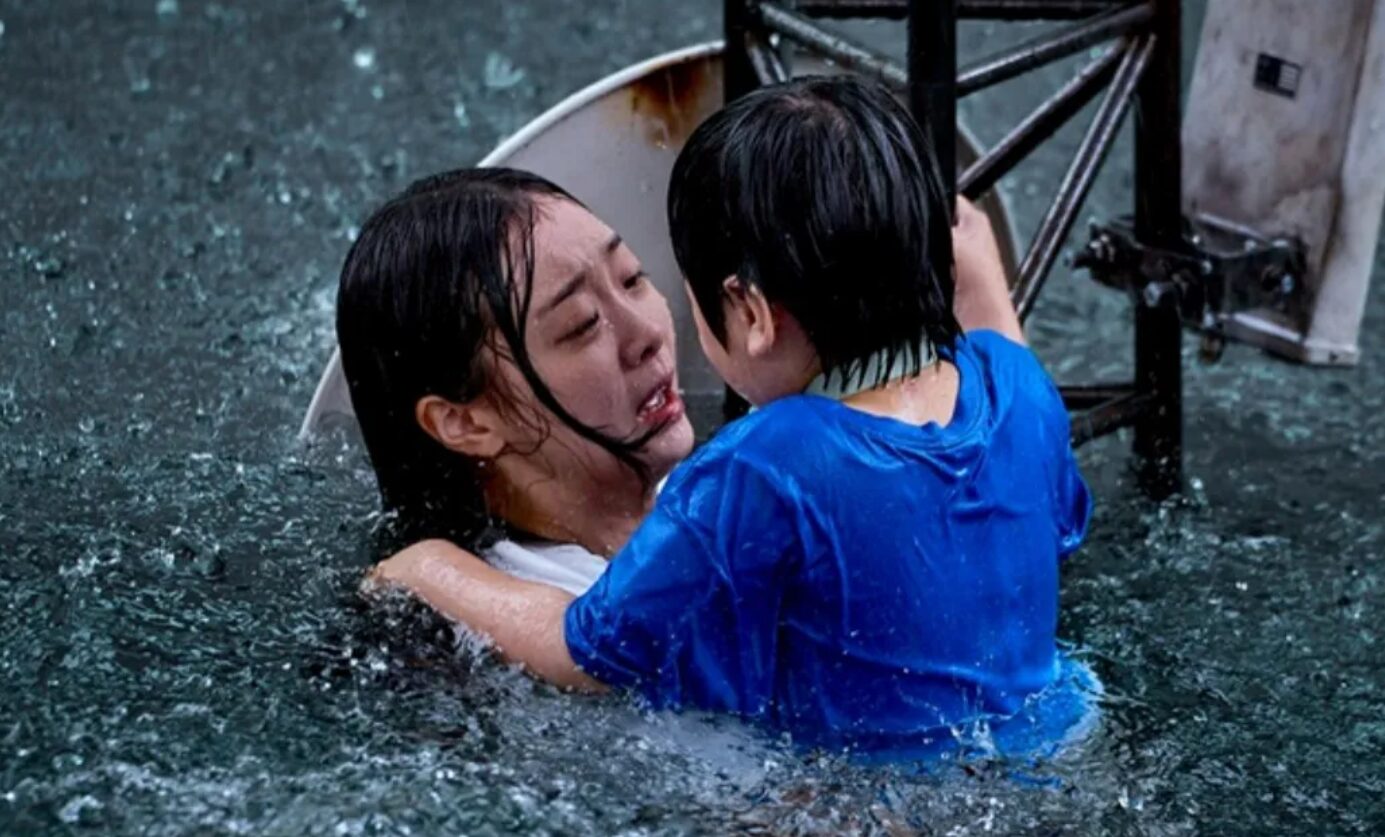
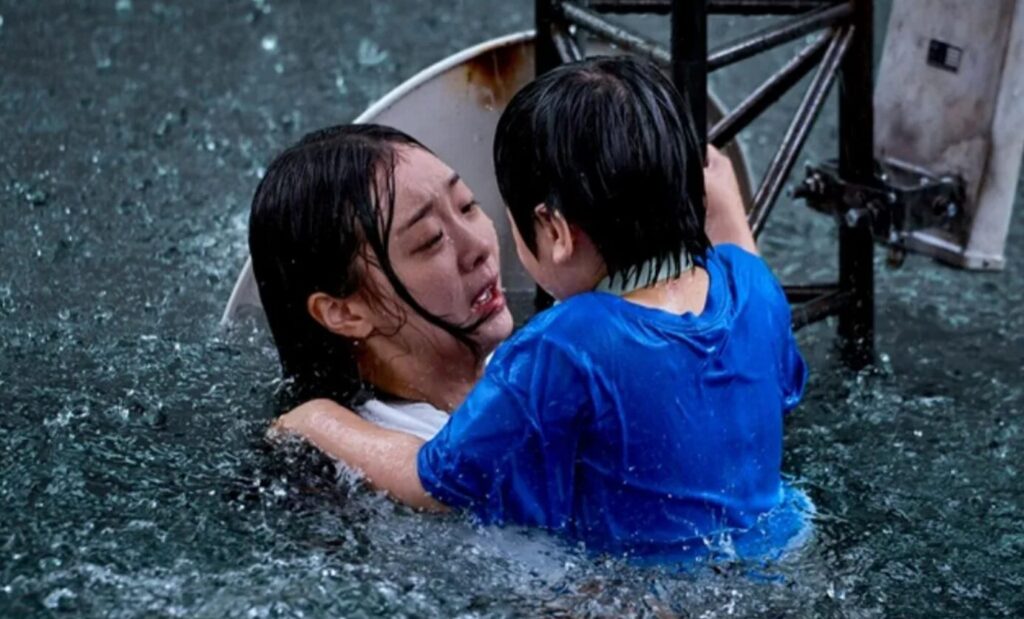
During this segment, the focus of the film is clear: AI researcher Gu Anna must escape the flooding apartment with her six-year-old son, Ji-an. With the appearance of Son Hee-jo, a member of the human resources security team, the story secures the “possibility of rescue.” Son Hee-jo is presented not as a mere rescue worker, but as someone specifically searching for Gu Anna. This setting plants an expectation in the audience that this film is not just an accidental disaster, but a story with specific “background circumstances.” However, this expectation does not lead to an explanation. The film turns its gaze back to the disaster scene without clearly defining Hee-jo’s mission. Scenes of nearly losing the child, submerged hallways, and moving while holding one’s breath follow, tethering the audience’s interest back to survival. In this process, the audience naturally accepts the film as a “disaster narrative testing motherhood(motherhood) in extreme situations.” Importantly, the film does not immediately correct the fact that this interpretation is incorrect.
Signals of a Crack: Another Story Was Already Underway
While the disaster narrative is in full swing, the film repeatedly inserts unexplained scenes and dialogue. The most prominent is the child Ji-an’s words. Ji-an asks, “Why am I always six years old?” stating he was six yesterday and the day before. This dialogue cannot be explained by a realistic setting, yet the film does not define or clarify it as an anomaly. The same applies to the child’s behavior. Ji-an acts as if predicting situations where his mother might lose him and repeatedly hides. He looks like a lost child but moves like someone who already knows the situation. The audience might interpret these scenes as “the child’s anxiety” or “traumatic reaction,” but the film does not finalize that interpretation. At this point, 「The Great Flood」 is already shedding its disaster movie skin, but that fact is not clearly conveyed. Instead of revealing the truth of its world-building, the film induces the audience to remain in the same state of confusion as the protagonist. Just as Gu Anna is forced to make choices without understanding the situation, the audience follows the story through incomplete information. This structure combines with the later-revealed sci-fi setting, becoming a key device explaining why the film feels unfriendly until the very end.
Humanity Is Already Finished: Isabella Lab and the Reality of the Reconstruction Project
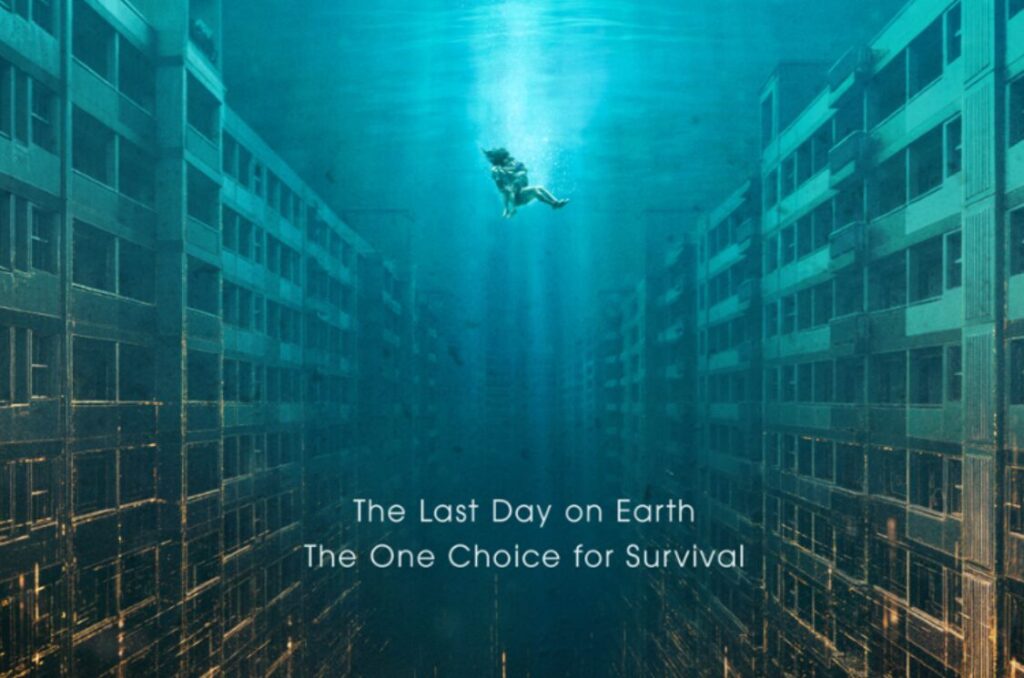
Only in the mid-to-late part of the film does the audience finally realize what kind of world the disaster they were watching was a part of. In 「The Great Flood」, the great flood is not a disaster yet to come, but an event that has essentially already made humanity extinct. The situation depicted as heavy rain and flooding was not a local disaster, but merely one facet of a global extinction triggered by an asteroid collision and the collapse of Antarctic glaciers. Most life on Earth has already disappeared, and the characters the audience followed were not “survivors waiting for rescue,” but beings closer to “selected resources.”
This setting is materialized through the Isabella Lab. Located outside the atmosphere, it is a research facility where only a tiny fraction of personnel evacuated for the reconstruction of humanity. The crucial point here is that the film does not treat human survival as a collective narrative. Stories of rebuilding government, society, or community are thoroughly excluded, and the narrative converges solely on the issue of creating the “minimum unit of humanity”—a pair of humans, or more precisely, a mother and child.
At this juncture, 「The Great Flood」 diverges from typical post-apocalyptic narratives. While most doomsday movies ask “how to survive,” this film first asks “what makes a human human.” Isabella Lab is a culmination of technology, but it is also a place where technology has hit its limit. Body, intelligence, and even reproductive capacity can already be implemented through cloning technology, but the final element that makes a human human—emotion—has not yet been perfected. The world after human extinction as set by this film is cold. Survival is treated not as a matter of numbers, but as a matter of conditions. A human who can survive must be more than a biological human; they must be a being that can reproduce “human-ness.” And the film chooses emotion—specifically a certain type of emotion—rather than reason or ethics as the core of that human-ness.

The Child Was Completed, and Now a Mother Had to Be Made
The sci-fi core of 「The Great Flood」 is not the setting of cloned humans itself. In this film, the human clone is already in its completion stage. The child Ji-an, code-named NewMan-77, possesses a body and intelligence indistinguishable from a person and is capable of learning and growing. The problem is not whether this child can “act like a person,” but whether he can “live like a person.” The film looks for that condition not within the child, but in the relationships surrounding him.
The point where the Darwin Center judged it had failed is clear. The Emotion Engine, the technology for embedding emotions into clones, did not work simply by inserting a program. Emotions can be learned, but certain emotions are only formed within relationships. The emotion the film focuses on here is motherhood. The emotion of protecting the child, sacrificing oneself for the child, and never giving up even after losing the child. The film sets this emotion as the final condition for constructing humanity. Thus, the Darwin Center’s conclusion is paradoxical: since the child is already finished, what must be made now is the mother. This mother does not necessarily have to be the biological mother. What matters is the role and the choice. A mother as a being that protects the child, and as a being that seeks the child until the end even when lost. The person chosen as the subject for this experiment is Gu Anna.
The scene where Gu Anna voluntarily decides to become a test subject is the most cruel moment of choice in the entire film. She enters the repeated simulations while maintaining her memories and emotions. Those simulations are the very stories of flooding, evacuation, parting, and searching that the audience followed from the start. Only at this point does the audience realize that most of the film they saw was not reality, but a repeated experiment to verify motherhood. This setting explains all the “unfriendliness” of the film. The repeated scenes, unexplained dialogue, the child’s predictive behavior, and the frequent partings are all part of the experimental design, not coincidences. The experiment is designed toward one question: Will this mother give up on the child, or will she find him until the end? If she fails, it resets to the beginning; if she succeeds, humanity persists. In this simple yet cruel structure, Gu Anna stands at the crossroads of the same choice thousands of times.
Why Did the Child Vanish Every Time? Motherhood’s Conditions in Repetitive Narratives
The cruelest setting of 「The Great Flood」 is not the repetition itself, but the fact that both the mother and the child change within that repetition. While Gu Anna faces the same flood, the same apartment, and the same crossroads every time, the child Ji-an does not. As revealed in the subtitled dialogue, Ji-an asks why he is “always six years old” and recognizes that he was six yesterday and the day before. This implies that the child is not a mere experimental subject, but a being that remembers or at least senses the repetition.
The child’s repeated disappearance is not an accident. Initially, Ji-an disappears like a lost child, but as experiments iterate, he hides intentionally. He enters closets, enters dark rooms, and distinguishes between places where his mother can and cannot find him. This is closer to an action chosen because he understands the situation all too well, rather than because he doesn’t. Every time, the child senses the possibility of his mother leaving him and disappears as if testing that choice.
This repetitive narrative leads to the film’s cold definition of motherhood. Motherhood is not a momentary feeling of holding and protecting a child, but a persistent choice of not giving up even after losing the child. In the film, the child is never once completely abandoned. However, he experiences the possibility that he “will be abandoned someday” every time. So he disappears, waits, and demands to be discovered again. The child’s disappearance is not a device to punish the mother, but a structure to push the mother’s choice to the limit. At this point, 「The Great Flood」 poses an uncomfortable question to the audience: Is protecting the child and not giving up on the child the same, or different? Every time, Gu Anna struggles to save the child, but at the same time, she wavers before the greater cause of reconstructing humanity. The child senses that wavering. Thus, within the repetition, the child hides further and waits longer, testing whether his mother will choose him until the end. This experiment does not conclude with emotional reward or touching sentiment. Instead, the audience realizes how cruel this process is and that the cruelty was intentional.
The Character Son Hee-jo: Observer and Audience Proxy
Son Hee-jo is the most easily misunderstood character in 「The Great Flood」. On the surface, he appears to be a rescue worker from the security team acting coldly to carry out his mission. However, as the film progresses, his role expands beyond a mere helper or hinderer to “the one who watches” the experiment. He is the person who observes the relationship between Gu Anna and Ji-an until the end to confirm the outcome.
Hee-jo’s repeated line, “The human heart is originally like that,” represents the emotional core of the film. While he cynically accepts the fact that humans are inevitably selfish, he simultaneously wants to see how that selfishness manifests until the very end. Specifically, he obsessively watches whether Gu Anna will ultimately choose the child or succumb to the cause of reconstructing humanity. This attitude stems not from simple malice, but from personal memory and deficiency.

As revealed in the latter half of the movie, Son Hee-jo is also someone who experienced being an abandoned child. Remembering his mother who left him, he reached the conclusion that “people are originally like that.” Thus, on the day the world ends, he wants to confirm if another mother makes the same choice. That confirmation is the only way to justify the wounds he suffered. In this regard, Son Hee-jo is not just a character in the play, but a proxy for the audience’s gaze. This is because the audience, while watching this film, asks the same question: Will that mother be different, or will she ultimately be the same? This is why Hee-jo neither stops nor actively helps Gu Anna’s choice in the end. He is an observer, not an intervenor. His existence directly reflects the attitude the film demands from the audience: Do not judge, do not expect—just watch until the end. What Hee-jo watches is not the survival of the child, but the moment motherhood is finally proven.
The Discomfort Left by a Film Experimenting on Motherhood
In 「The Great Flood」, motherhood is treated not as a respected emotion, but as a condition to be passed. The film doesn’t ask, “What did this mother want?” Instead, it asks, “Does this mother hold out until the end?” The moment Gu Anna becomes a test subject, she is no longer the subject. Her emotions, memories, and pain become data. If she fails, she is reset, returns to the beginning, and repeats the same pain thousands of times. In this structure, motherhood becomes a performance metric rather than a language of relationship. It becomes an object of measurement—whether she seeks the child until the end, whether she doesn’t give up, whether her emotions do not fade. The discomfort felt at this point is justified because the film portrays motherhood as a noble emotion while simultaneously instrumentalizing it.
The conclusion presented by this film is clear: motherhood was what made us human. However, this proposition leaves one question: Then, is a human without motherhood not human? The film doesn’t ask this directly, but its narrative structure makes the question unavoidable. If the core condition for reconstructing humanity is “the emotion of not giving up on a child until the end,” then a being that cannot perform that emotion is disqualified. This logic is very dangerous because motherhood is not a universal emotion, but one formed within historical, social, and personal conditions. Furthermore, the film leaves this role almost entirely to the female body and emotions. Gu Anna was chosen because she is a mother; Son Hee-jo can be an observer but not a test subject. Whether intentional or not, this structure carries the risk of fixing motherhood as the essence of womanhood. This is where the audience’s discomfort arises.
Did the film then create a violent narrative without recognizing this discomfort? I do not see it that way. Rather, 「The Great Flood」 is a film that leaves this discomfort unresolved. Gu Anna ultimately chooses to become a test subject, but that choice is neither victory nor salvation. It is a decision to save humanity and, at the same time, a choice that exhausts herself. The film does not beautify that choice. The repeated pain, the child’s wounds, and the mother’s oblivion are never cured. Humanity survives, but the price is clearly presented. Thus, the discomfort of this film is closer to a strategy to leave an ethical question rather than a signal of failure. The film doesn’t say, “This is right.” Instead, it asks the audience, “Can we accept humanity that survives in this way?”
The Limits and Courage of a Film Experimenting on Motherhood
The strongest impression left by 「The Great Flood」 is discomfort rather than being moved. That discomfort stems not simply from confusion caused by lack of explanation, but from the film’s way of questioning. While talking about motherhood, this film does not protect motherhood. Rather, it tests, repeats, fails, and finally judges whether motherhood has passed.
This approach has clear limits. The first is that motherhood is set as an overly singular condition. The moment motherhood is chosen as the emotion that makes humans human, those who cannot perform that emotion are excluded from the narrative. While the film intentionally remains silent, questions arise within that silence: Is a human who lacks the emotion of not being able to give up on a child until the end not a human, or unqualified for the reconstruction of humanity? This question cannot be easily answered, and the film does not provide one.
Another limit is that this experiment is conducted almost entirely upon the female body and emotions. Gu Anna becomes the test subject, and Son Hee-jo becomes the observer. Motherhood is fixed as a female role, and male characters are placed in a position to watch and evaluate that choice. Regardless of intent, this structure implies the risk of reducing motherhood to a female essence. Whether the film was sufficiently aware of that risk remains a question.
However, at the same time, the fact that this film did not evade this discomfort is a clear act of courage. 「The Great Flood」 does not glorify motherhood. It doesn’t wrap it in noble images. Instead, it pushes motherhood as a condition and shows until the end how cruel that condition is and how much repetition and injury it requires. The film is intentionally designed so that the audience feels uncomfortable with this experiment. That discomfort is not the director’s immaturity, but a strategy to leave a question.
Thus, while this film speaks of motherhood, it does not offer comfort. Humanity survives, but what emotions are consumed and what memories are repeatedly destroyed in the process are never recovered. 「The Great Flood」 does not affirm survival; it leaves the price of survival. In this regard, instead of choosing a safe ethical conclusion, this film hands the uncomfortable question directly to the audience.
What Saved Humanity Was Emotion, Not Technology
At the end of the film, the Emotion Engine is completed. The memories of Gu Anna and Ji-an are transmitted to Isabella Lab, and based on those memories, a new cloned mother and child are created. Outwardly, this scene looks like hope. Humanity is not extinct, and the possibility of returning to Earth has opened. However, this conclusion is not a simple happy ending. What matters is not what survived, but what was sacrificed. What survived in this film was not the body or technology, but a specific pattern of emotion: the emotion of not giving up on a child until the end, the memory of choice that does not disappear despite repetition. That emotion is completed only after thousands of failures and pains. Humanity survives that way. However, that humanity is already a different being from the previous one.
In this conclusion, 「The Great Flood」 makes no clear declaration. Whether this choice was right or whether this method of reconstruction is justified, the film does not judge. Instead, it asks the audience: Can we accept humanity that continues in this way, or is this the beginning of another failure? This is exactly why the film feels unfriendly—because it gives no answer and leaves only questions.
「The Great Flood」 is not a friendly movie. It provides no genre pleasure, no emotional resolution, and no clear explanation. Instead, this film demands one thing from the audience: to watch until the end, and to think until the end. This demand is burdensome and sometimes unpleasant. Thus, it is hard for this film to be easily loved. However, thanks to this very unfriendliness, 「The Great Flood」 becomes a film that lingers. Starting as a disaster movie and transitioning into sci-fi, this story ultimately converges on the question of what conditions make a human human. The way it asks is problematic, holds limits, and simultaneously shows the courage not to evade.
The film’s declaration—that since the child was made, a mother had to be made—is closer to a warning than a tribute. There are emotions that technology cannot replace, and this film does not hide the fact that attempts to reproduce those emotions always involve violence and discomfort. 「The Great Flood」 is a film that speaks only to those audience members prepared to endure that discomfort. And at that very point, this film remains both a failure and a problematic masterpiece.
#TheGreatFlood #NetflixFilm #KoreanSciFi #DisasterMovie #MotherhoodNarrative #ReconstructionOfHumanity #EmotionEngine #FilmCriticism #SpotlightU




Leave a Reply